
What the regional transportation tax would raise, and what its wording allows
The ballot estimates $7.9 million in the first full year, 6.3 times the figure council saw in August, and its wording would let the authority spend the money on more than buses.
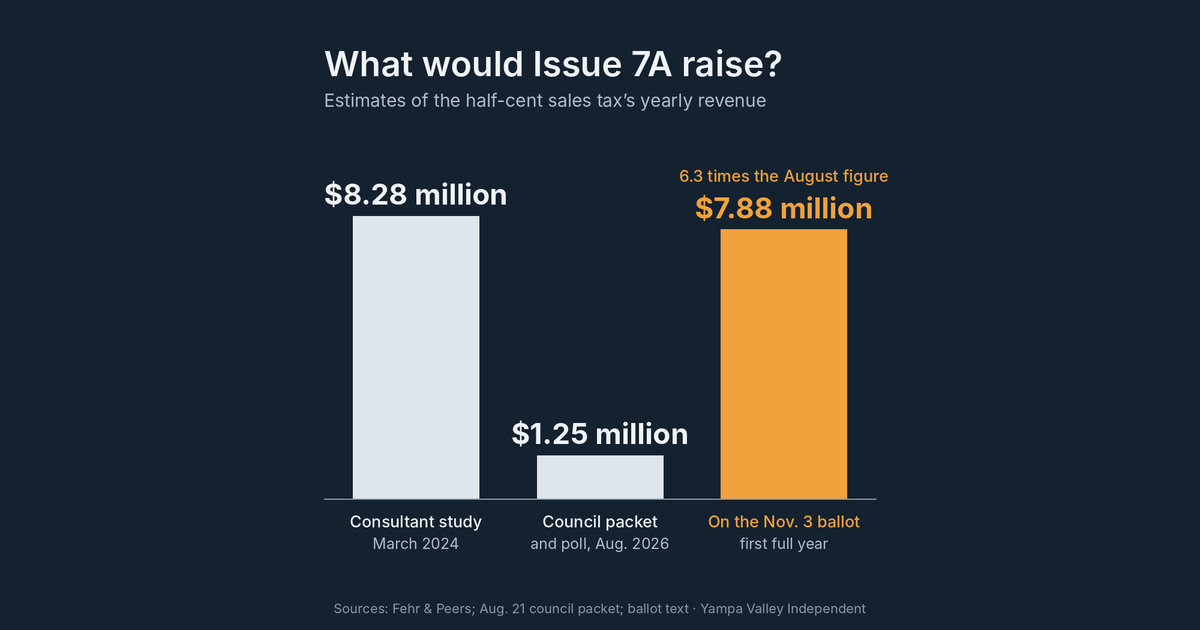
STEAMBOAT SPRINGS — Voters across the Yampa Valley Regional Transportation Authority’s territory, including Steamboat Springs, will decide Nov. 3 whether to add a half-cent sales tax that the ballot estimates would raise $7,875,197 in its first full year. In August, when Steamboat’s City Council weighed in on the ballot language, its meeting packet and a poll presented to the authority’s board used an estimate of $1.25 million, a figure council members said at the meeting was wrong.
The ballot question’s wording would also let the authority spend the money on more than buses. In August, council member David Barnes proposed capping spending on highway safety, wildlife crossings and crosswalks at 10% of the tax each year, and two colleagues supported limits. Council then voted 4-1, with Barnes in the majority, to approve the language as presented. The ballot question sets no cap, and the Independent has not seen the resolution the authority’s board adopted.
If approved, the tax would start Jan. 1, 2027, at 50 cents on every $100 of taxable purchases. It would apply to the same purchases as the state sales tax, with the same exemptions; groceries and residential utilities would not be taxed, according to a city attorney’s memo.
What it adds up to
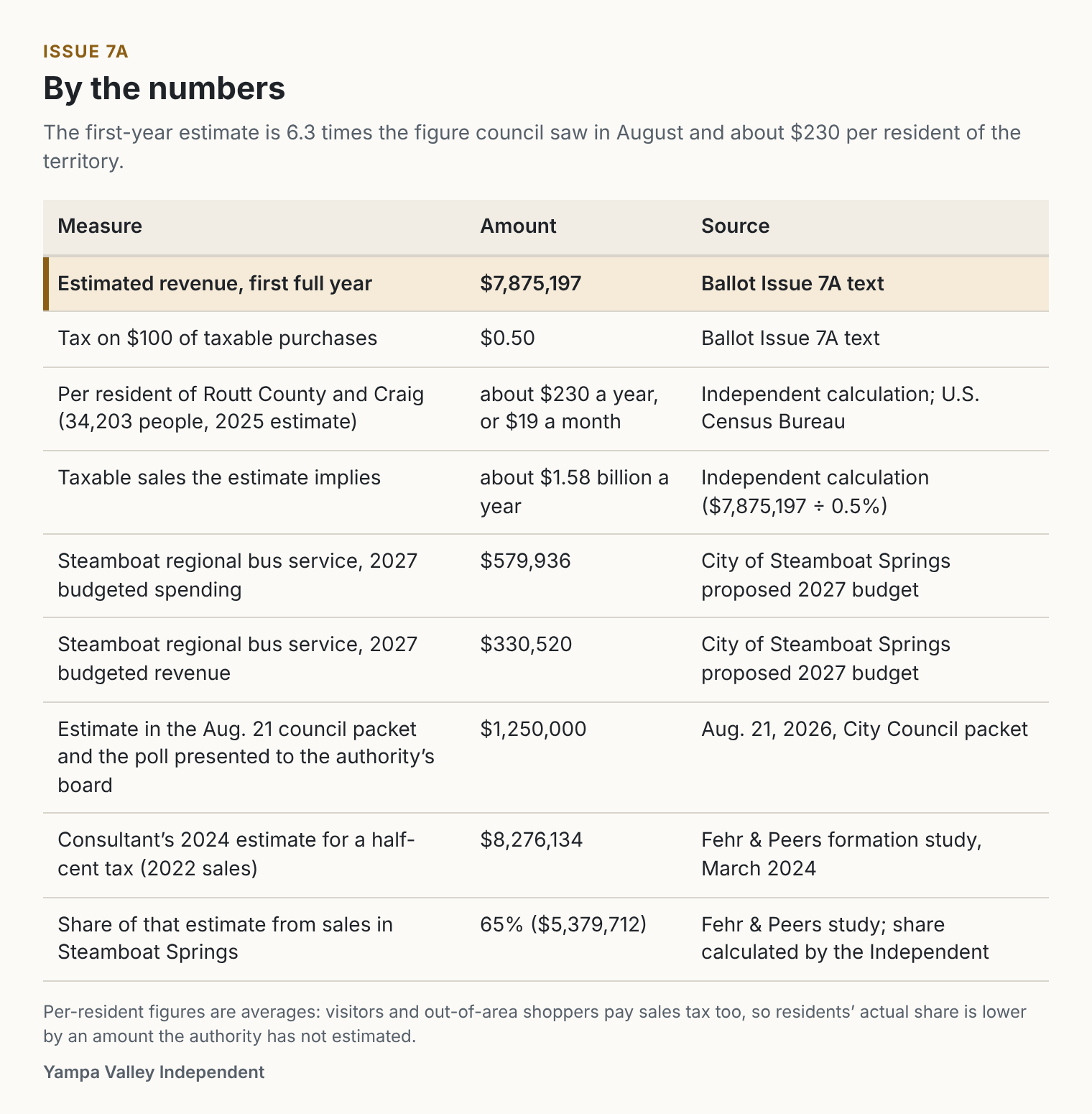
The first-year estimate works out to about $230 for every resident of Routt County and Craig, using the Census Bureau’s 2025 population estimates. That is an average, not a bill. Sales tax is paid by everyone who shops in the territory, including visitors, and the authority has not said what share it expects them to pay.
To raise $7.9 million at a half-cent rate, taxable sales in the territory would have to total about $1.58 billion a year, by the Independent’s calculation.
The estimate also is not a cap. The question asks to raise taxes by $7,875,197 “and by whatever additional amounts are raised annually thereafter.” It includes no end date. It also asks voters to let the authority “collect, retain, and spend all revenues” from the tax above the annual limits in the Taxpayer’s Bill of Rights, or TABOR.
A sixfold change in the estimate
The August figure appeared in both city and authority documents. A memo from City Attorney Dan Foote for council’s Aug. 21 special meeting said the tax “is estimated to raise $1,250,000 in its first year,” and a draft ballot title attached to the board’s resolution showed the same figure in brackets. A New Bridge Strategy poll of 300 registered voters in the district, taken July 25–30, tested a version of the question with that figure: 51% of the 150 voters who saw the half-cent version said they would vote yes and 32% said no. A one-cent version, at $2.5 million, drew 42% yes and 40% no.
The poll also tested different purposes from the ones on the ballot. In the version poll respondents saw, the safety purpose read “enhancing public safety by maintaining and improving pedestrian access, crosswalks and wildlife crossings,” with no mention of U.S. Highway 40. Highway 40 appeared instead in two of six supporting statements the poll tested. One said there had been more than 230 crashes between Steamboat Springs and Craig on the highway in two years and that more transportation options would improve safety “by reducing the number of cars on the road, decreasing the risk of accidents, and providing safer alternatives for residents and workers traveling between communities.” Forty-three percent of the voters asked called it very convincing, the highest of the six. The other, about improving congested intersections off Highway 40 and the only statement about road work, was the least convincing; 15% called it very convincing. The ballot’s first purpose repeats the crash statement’s closing words but drops the reference to fewer cars on the road. The polled versions also promised that all spending would be reported in an annual independent audit and disclosed on the authority’s website; the final ballot question does not.
The number on the ballot, $7,875,197, is 6.3 times the August estimate. At the Aug. 21 meeting, council member Bryan Swintek, the city’s alternate on the authority’s board, said the revenue estimate used in the poll was incorrect and that he had asked the board to postpone its vote. Mathew Mendisco, Hayden’s town manager and secretary of the authority’s board, spoke about the state requirement to put an estimate on the ballot, the uncertainty in such estimates and basing the final figure on each member government’s actual budget, according to the minutes. Barnes said he was concerned by how far the projection differed from the actual figure, and a public commenter put the larger amount at about $7.5 million.
The larger figure is close to what a consultant projected before the authority existed. A March 2024 formation study that Fehr & Peers prepared for Routt County, Steamboat Springs and Craig, included in the council packet, estimated that a half-cent tax would raise about $8.28 million a year based on 2022 sales, with $5.38 million, or 65%, collected in Steamboat Springs. The Independent asked the authority how the ballot figure was calculated and whether it considered polling again with the corrected number.
More than a bus tax
In Steamboat’s budget records, the authority comes up in connection with buses: the City Council expects it may eventually take over the regional bus service the city runs now. But the ballot question never uses the word “bus.” The word “transit” appears once, to describe areas that are “not currently served by transit.”
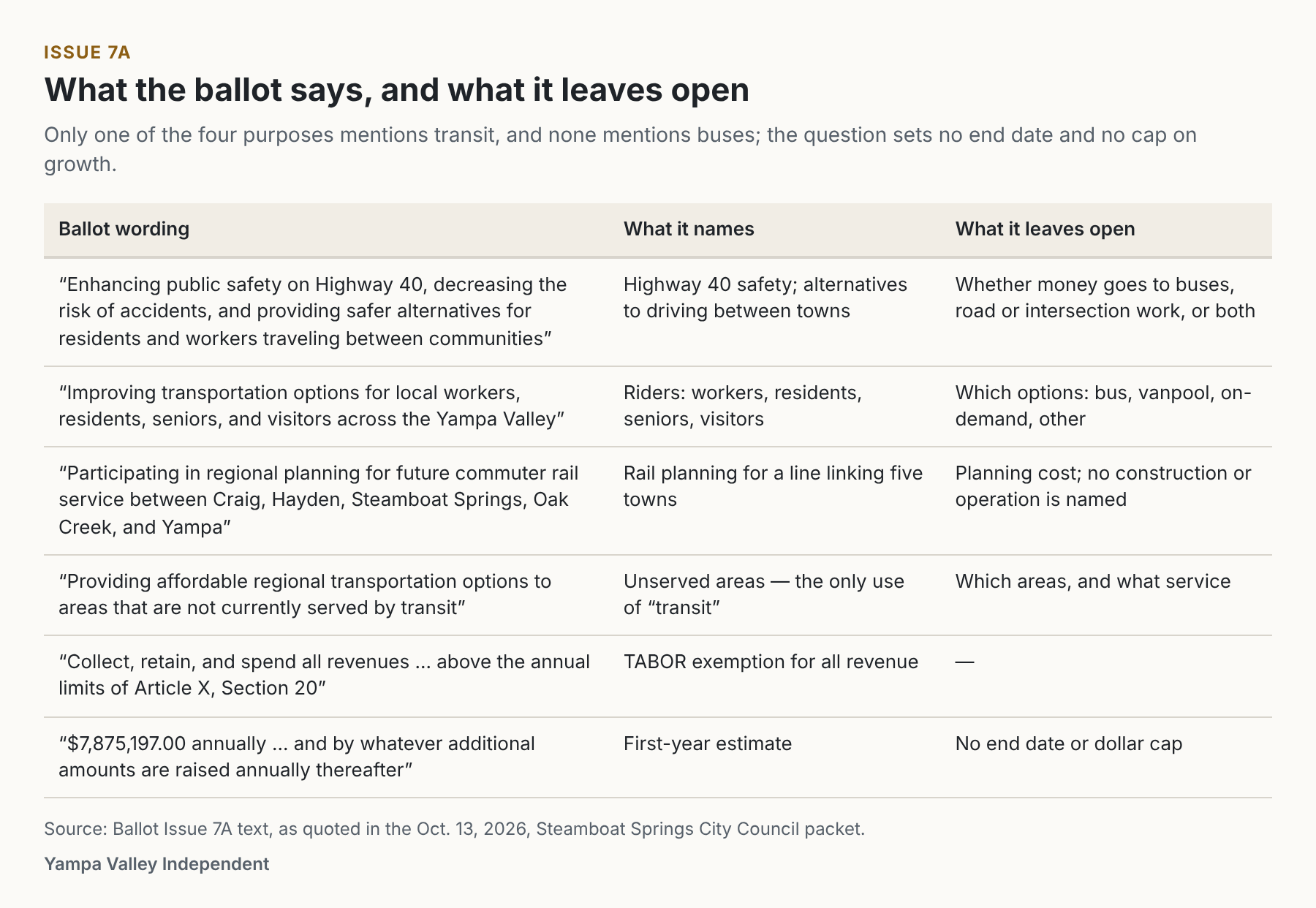
The question lists four purposes:
- “Enhancing public safety on Highway 40, decreasing the risk of accidents, and providing safer alternatives” for travel between communities.
- “Improving transportation options for local workers, residents, seniors, and visitors across the Yampa Valley.”
- “Participating in regional planning for future commuter rail service” between Craig, Hayden, Steamboat Springs, Oak Creek and Yampa.
- “Providing affordable regional transportation options” to areas without transit.
The first purpose ties highway safety partly to “safer alternatives” to driving, but its wording does not limit the money to buses or name specific projects. The rail purpose covers planning, not building or running a train. Colorado’s Regional Transportation Authority Law defines the systems an authority may fund to include highways, roads and streets as well as bus and rail systems, and requires that sales tax proceeds go to financing, building, operating or maintaining those systems. It bars work that would alter a state highway, such as Highway 40, without an agreement with the Colorado Department of Transportation, and it leaves the specifics to the authority’s founding agreement. The authority’s intergovernmental agreement, in the version council reviewed in August 2025, lists eight initial service goals, “including, but not limited to”: six involve buses, bus stops, park-and-ride lots and airport ground transportation; one would “support roadway safety improvements such as crosswalks and other pedestrian improvements, especially adjacent to bus stops on regional routes,” and wildlife crossings, through planning, coordination and possible matching funds; and one covers rail planning, also with possible matching funds.
None of that means the authority plans to spend the money on roads. The ballot language does not say how the money would be split among the four purposes, and it does not rule out road-safety spending. The Independent asked the authority how it intends to divide the first year’s revenue among the four purposes.
What council debated
Barnes raised the spending question in a memo to his colleagues dated Aug. 21, the day of the special meeting. He wrote that the public-safety language was “broader than the Authority’s core transit mission”; that passing lanes, safety measures and wildlife crossings on Highway 40 normally fall to the Colorado Department of Transportation; and that broad categories could let future boards fund local projects voters never approved. He proposed replacing the Highway 40 bullet with language about bus service, bus stops, park-and-ride lots and connections to transit, and requiring that at least 90% of the tax go to regional transit each year, with pedestrian, highway-safety and wildlife spending capped at 10%. The memo said it was “not a recommendation to oppose the tax measure.”
At the meeting, Barnes said the poll’s misstated revenue did not change his support for the authority and that he wanted limits in the ballot language, according to the minutes. He clarified that he was not seeking to remove the safety language, only to cap spending on those items at 10% a year. Swintek said that if the board would not add a cap or remove the language, he wanted council member John Agosta, the city’s representative on the authority’s board, to vote against it or abstain, and Barnes and council member Michael Buccino agreed. Council, which had been asked only for direction to its board members, then voted 4-1 to approve the ballot language as presented, on a motion by Agosta. Council President Steve Muntean, Agosta, Barnes and Buccino voted yes; Swintek voted no; and council President Pro Tem Gail Garey and member Amy Dickson were absent. Agosta said the polling firm still considered the poll valid and that the board did not want to limit possible solutions; Swintek said he supported the authority and a November vote but objected to the process and asked why the poll results had not been shared sooner, according to the minutes. After the vote, Buccino suggested recommending that the board cap highway-safety, wildlife-crossing and pedestrian spending at 10%, and Assistant City Attorney Jennifer Bock said such language might fit better in the authority’s intergovernmental agreement. Swintek asked Agosta to request that the board reconsider and appear at council’s Sept. 1 meeting.
The ballot question now before voters lists the same four purposes as the draft, word for word, and sets no spending limit. Council’s Sept. 1 agenda listed no presentation from the authority, and minutes of that meeting had not been posted as of Oct. 10, so the Independent could not determine whether board members addressed council there. The Independent asked the authority whether its board considered the 10% limit or a change to its agreement.
The case for the tax
Six governments — Routt County, Steamboat Springs, Craig, Hayden, Oak Creek and Yampa — formed the authority through an intergovernmental agreement, and voters approved it in November 2025, according to a city memo. Its board referred the tax to the ballot in August.
Supporters say the valley needs the service. At the Aug. 21 meeting, speakers from the Safe Crossing Committee, the Western Resilience Center, the CAP transportation working group and Friends of YVRTA urged council to support putting the tax before voters, citing Highway 40 safety, commuting costs and emissions. Two other speakers raised doubts: one asked how the authority would sell voters on the larger amount, and another said Steamboat residents would provide most of the money without serious discussion of what they would get, the minutes show. Buccino said the question forming the authority had passed with 89% of the vote, according to the minutes.
Pending a decision on a revenue source, the authority’s funding was expected to come from Steamboat Ski & Resort Corp., which pledged $1 million a year for 2026 through 2028 and agreed to negotiate, by April 1, 2027, an extension through 2046, according to a city memo and the intergovernmental agreement council reviewed in August 2025. The pledge ends if voters approve a ski-lift tax before 2029; in that case the city would owe the authority $1 million a year of lift-tax revenue through 2046. On Sept. 2, 2025, council voted 4-2 against sending a lift tax to voters.
On Tuesday, the Steamboat Springs City Council is scheduled to consider a consent-calendar resolution that “strongly supports” the authority’s goals, calls the tax “critical to advance” them and “urges the residents to vote YES.” The city manager’s memo lists the resolution’s fiscal impact as “NA.”
How Issue 7A compares
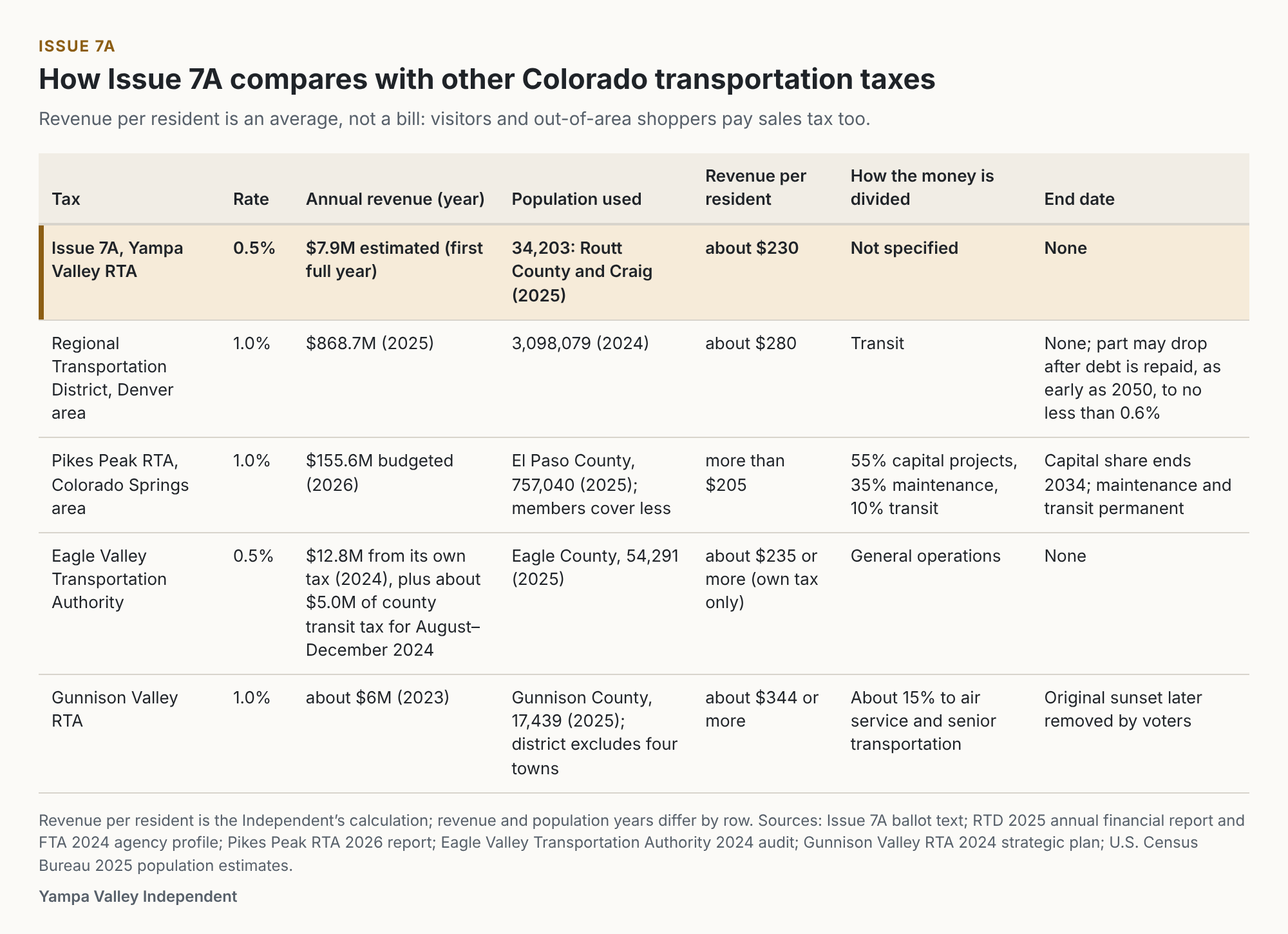
Issue 7A’s rate is half that of the Denver-area Regional Transportation District and the Pikes Peak Rural Transportation Authority, and the same as the Eagle Valley Transportation Authority’s, approved by voters in its Eagle County district in 2022, though Eagle Valley also receives most of a separate county transit tax. Per resident, its first-year estimate, about $230, falls within the range of the others. Unlike the Pikes Peak tax, it sets no split between transit and roads, and unlike Pikes Peak’s capital portion, it has no end date.
Revenue per resident is the Independent’s calculation and overstates what residents pay where visitors shop, including in the Yampa Valley; revenue and population years differ by row, as shown. A separate measure also labeled Issue 7A, a 0.333% sales tax for the Front Range Passenger Rail District, is on ballots only in Front Range communities. Some city and county bus systems spend less per resident on operations, counting money from all sources: Fort Collins’ Transfort, with the city’s general fund its main local source, about $107 in 2024, and Greeley-Evans Transit, Pueblo Transit and Grand Valley Transit $42 to $55, according to Federal Transit Administration profiles.
What it could mean for the city
Steamboat’s proposed 2027 budget sets aside $579,936 for the regional bus service, against $330,520 in revenue. The tax’s first-year estimate is about 13.6 times that spending. If Steamboat’s share of collections matched the consultant’s 2024 estimate of 65%, about $5.1 million of the first-year total would come from sales in the city.
The council’s 2027 goals call for a plan to hand over vehicles, spare parts and the Regional Transit Facility “assuming the RTA eventually takes over the regional bus service.” Under the 2025 agreement, the authority is to cooperate with the city to take over the regional route within three years of the authority’s formation “to the extent reasonably possible,” with the city’s Steamboat Springs Transit buses still running routes inside Steamboat. The agreement makes the authority’s duties subject to available funds and says it will first contract with the city to keep the regional route running. City records do not say whether that depends on Issue 7A or would free up city money. The Independent asked the city.
What’s next
- Tuesday, Oct. 13, 5 p.m.: City Council considers the resolution backing Issue 7A, item 2 on the consent calendar, at Centennial Hall, 124 10th St., or on Zoom (meeting ID 985 289 877). Anyone can ask that it be pulled for discussion before the consent vote; written comments go to citycouncil@steamboatsprings.net.
- Mid-October: mail ballots go out to voters in Routt County and Craig.
- Tuesday, Nov. 3: Election Day.
- Jan. 1, 2027: the tax would take effect if approved.