
Colorado's top income tax rate jumps from Utah's level into the top 10 with New York
Amendment 87's 8.4% rate on income over $1 million moves Colorado from 30th to 10th among the 50 states and D.C. starting in 2027, and makes it the highest in the Mountain West. Six charts for Steamboat property owners and investors.


Key points
- Colorado voters approved Amendment 87, which replaces the state's 4.4% flat income tax with six brackets from 3.7% to 8.4% starting with the 2027 tax year, according to unofficial results and the Associated Press.
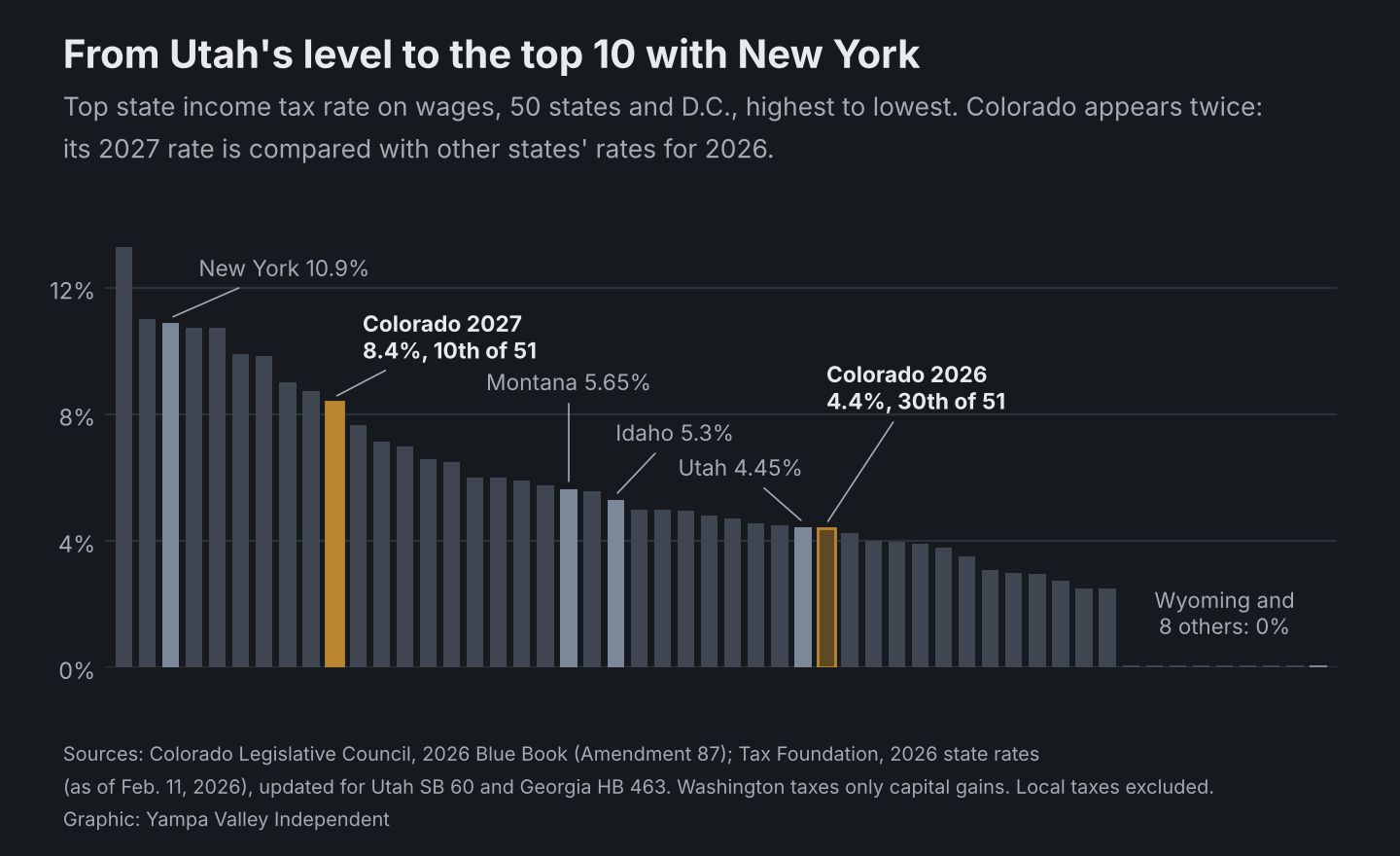
- By the Independent's calculation against other states' 2026 rates, Colorado's top rate moves from 30th to 10th among the 50 states and D.C. Only California, Hawaii, New York, New Jersey, D.C., Oregon, Minnesota, Massachusetts and Vermont would be higher.
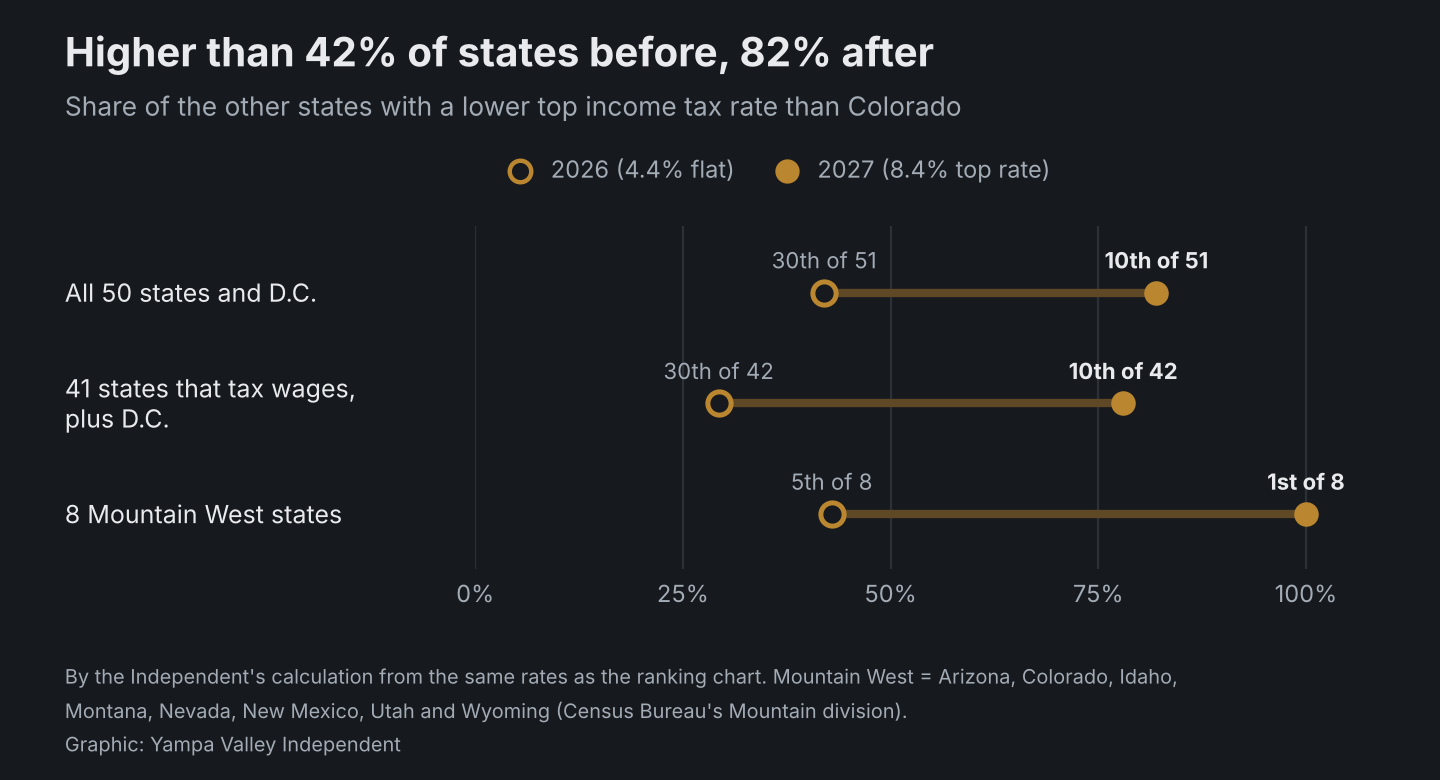
- Among the eight Mountain West states, Colorado goes from fifth to highest, above Utah, Idaho, Montana and Wyoming, but stays below New York's 10.9%.
- Anyone with taxable income below $510,834 pays less, by up to $325; above that, the bill rises. On $2 million of taxable income, the tax goes from $88,000 to $143,925.
- The rates apply to federal taxable income, which includes capital gains, so one large property sale can reach the top brackets.
This year, Colorado's flat 4.4% income tax sits a hair below Utah's 4.45%. Starting with the 2027 tax year, Colorado's top rate will rank among the 10 highest in the country, alongside New York and California, after voters approved Amendment 87 last week, according to unofficial results.
For most Steamboat households the change is a small cut. For investors and second-home owners with large incomes, or a large sale, it brings the highest top rate in the Mountain West.
How Colorado ranks
Measured by its top rate, Colorado was 30th of the 50 states and D.C. in 2026, higher than 21 of the other 50. At 8.4%, it would be 10th, higher than 41, by the Independent's calculation against other states' 2026 rates. Counting only the 41 states that tax wages, plus D.C., it moves from 30th to 10th of 42.
Other states can change their rates before 2027. Montana's top rate is already set to fall to 5.4% next year, and Montana's governor proposed a flat 4.7% in September.
Ski states and New York
Colorado's 8.4% applies to taxable income above $1 million. The measure sets one bracket schedule for every individual, so the threshold is the same for single filers and married couples.
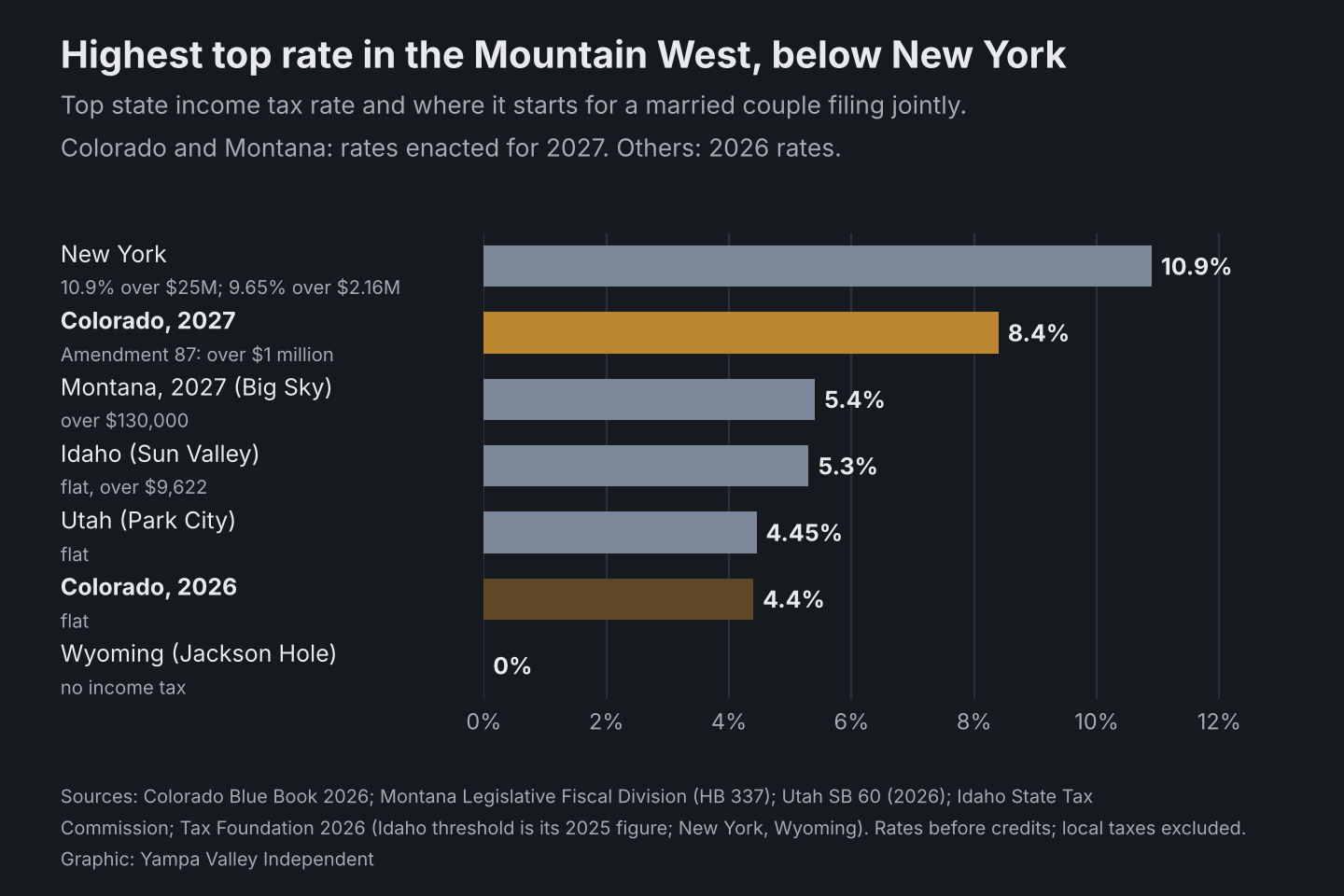
Wyoming has no income tax. Utah taxes income at a flat 4.45% after its sixth straight cut this year, and Idaho at a flat 5.3%. Montana's top rate is 5.65% this year and 5.4% in 2027, on income above $130,000 for married couples.
New York's top rate is higher, 10.9%, but starts at $25 million. Its 9.65% bracket starts at $2,155,350 for married couples and $1,077,550 for single filers. New York also takes back the benefit of its lower brackets from many high earners, and it has local income taxes that the state figures here leave out.
What it means in dollars
The new rates cut the tax on the first $100,000 of taxable income, leave the rate at 4.4% up to $500,000, then rise in three steps.
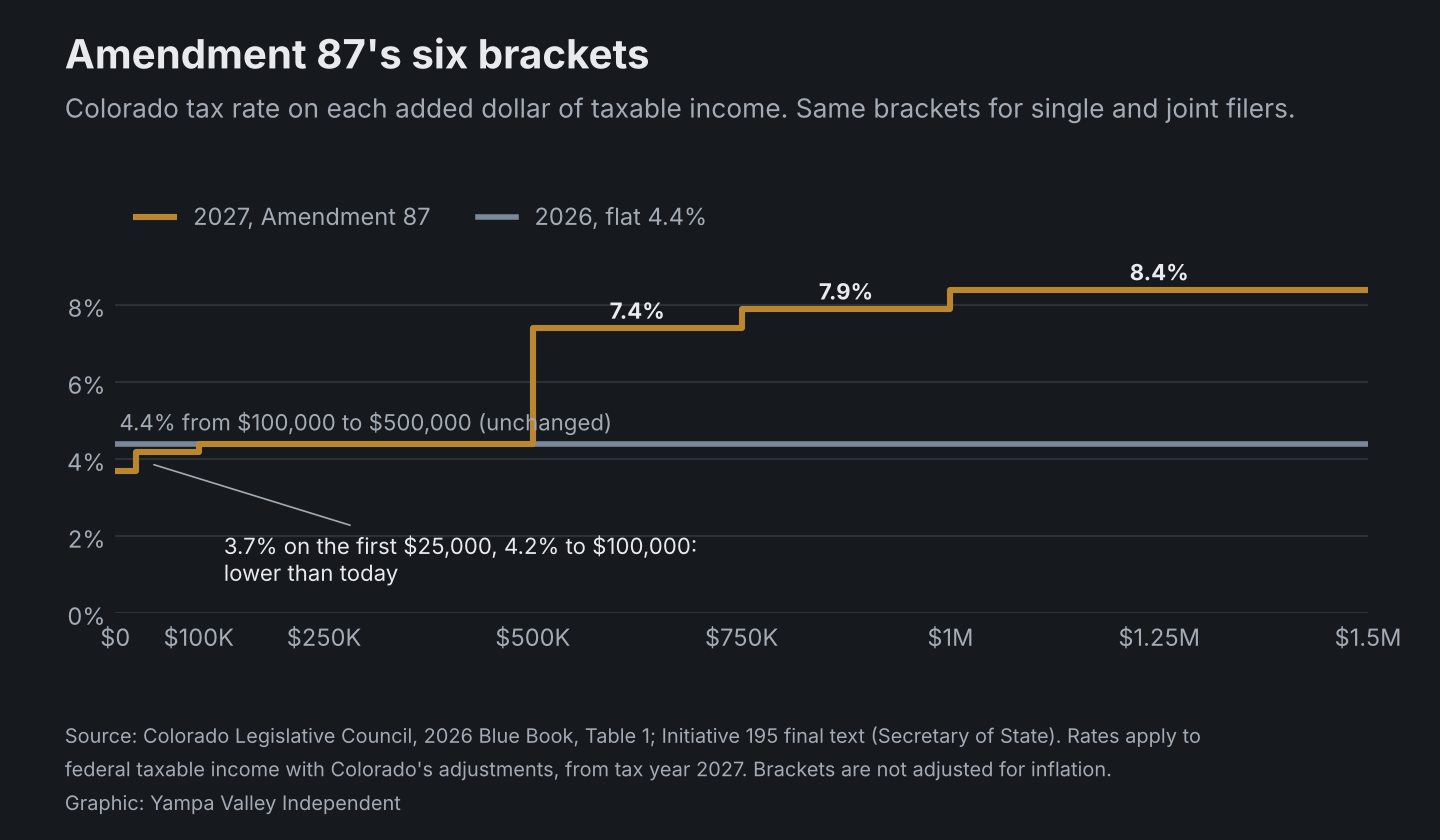
Anyone with taxable income below $510,834 pays less, by up to $325 a year, according to the state's nonpartisan Legislative Council staff. At $510,834 and above, the bill goes up.
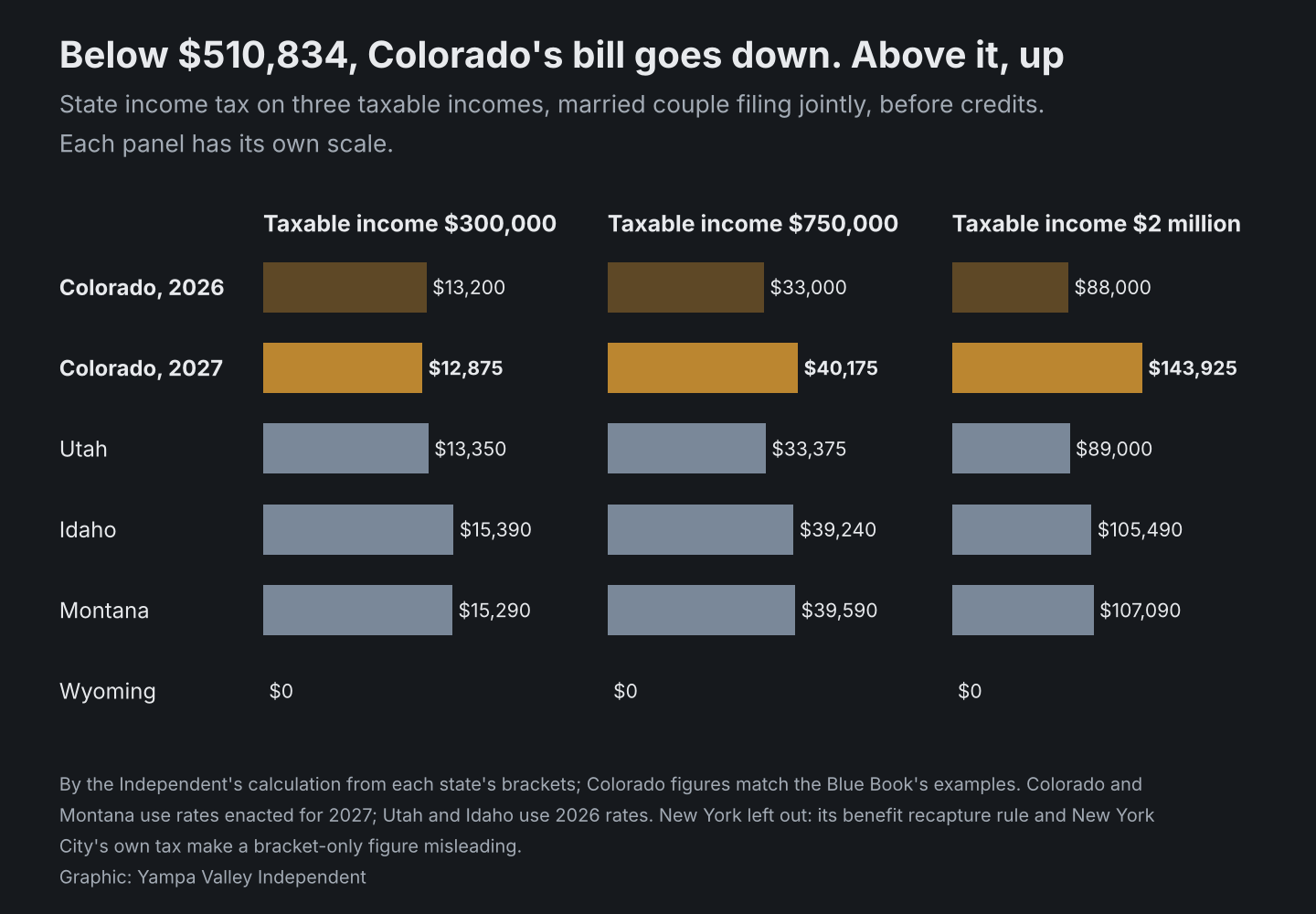
On $750,000 of taxable income, Colorado's tax would be $40,175, a bit more than Montana's $39,590 or Idaho's $39,240. On $2 million, it would be $143,925: $36,835 more than Montana and $38,435 more than Idaho, by the Independent's calculation.
The brackets aren't adjusted for inflation, so more income will fall into the higher brackets over time, the staff analysis says.
Selling a property
Amendment 87's rates apply to federal taxable income, which includes capital gains. A seller with a large gain in one year can reach the 7.4% to 8.4% brackets.
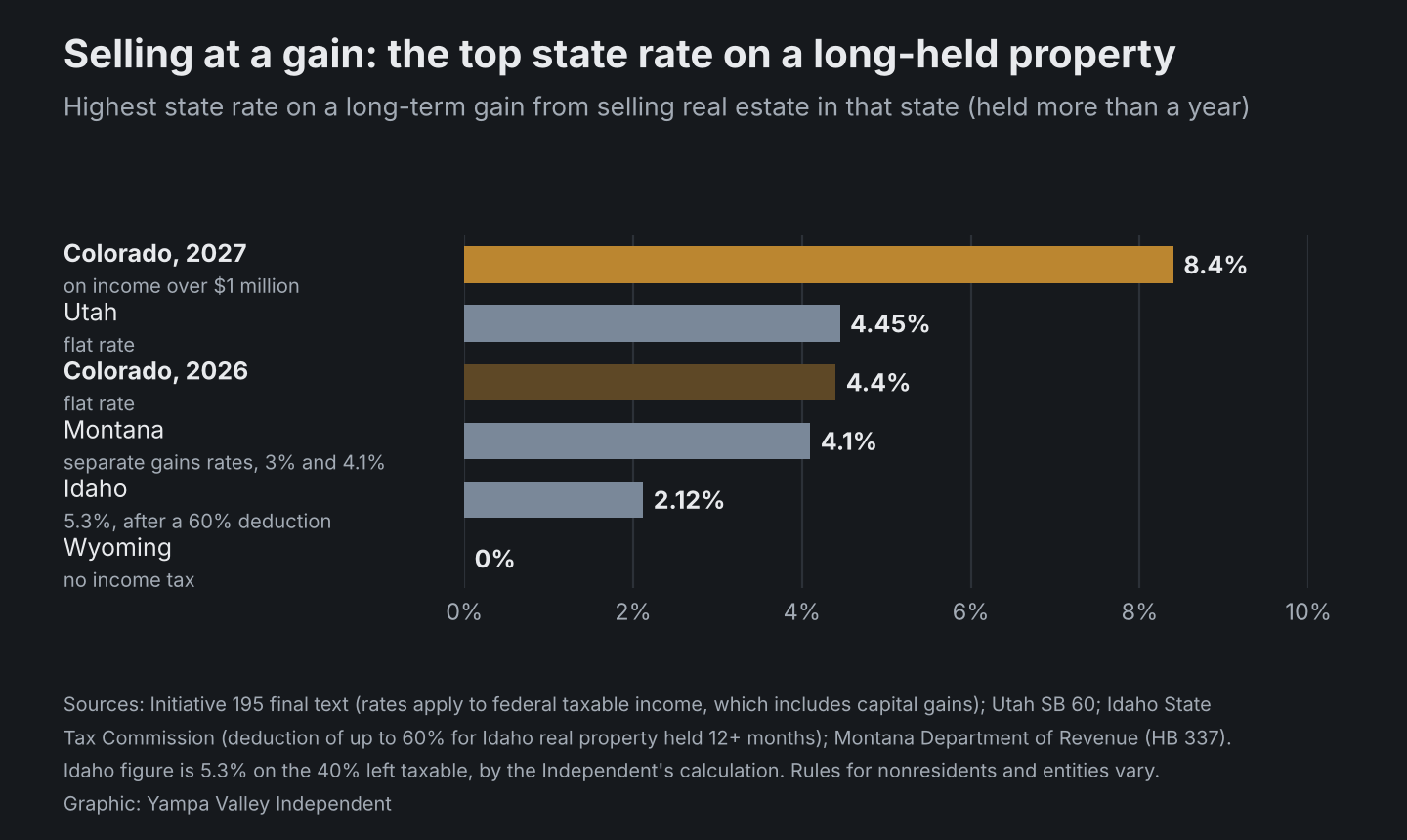
Two other ski states tax those gains at lower rates. Montana taxes long-term capital gains at separate rates of 3% and 4.1%. Idaho lets owners deduct up to 60% of the gain on Idaho real property held at least 12 months, which leaves an effective top rate of 2.12% by the Independent's calculation.
What we don't know yet
- Final results. The figures are unofficial until the Secretary of State certifies them.
- Out-of-state owners. Today, Colorado's Department of Revenue has nonresidents figure their tax as if they were full-year residents, then pay the share tied to their Colorado income, such as rent or a gain on Colorado property. Under that method, the bracket would follow an owner's total income. Whether the department keeps that method for 2027 is a question for the department.
- Other states. Utah has cut its rate six years running, and Montana's governor wants a flat 4.7%. Any change before 2027 would move these comparisons.
- The money. The new revenue must go to K-12 education, health care and early childhood programs; the legislature decides which ones.
Sources
- Colorado Legislative Council, 2026 Blue Book: Amendment 87 (brackets, examples, the $510,834 break-even, inflation, spending)
- Initiative 195 final text, Colorado Secretary of State (rates on federal taxable income from 2027)
- Chalkbeat Colorado, Nov. 6 (the Associated Press call; Proposition 136 rejected)
- Tax Foundation, State Individual Income Tax Rates and Brackets, 2026 (all states, as of Feb. 11, 2026)
- EY Tax News: Utah S.B. 60 and Utah House, 2026 session (4.45% from Jan. 1, 2026)
- EY Tax News: Georgia H.B. 463 (4.99% from Jan. 1, 2026)
- Idaho State Tax Commission (5.3%) and its capital gains deduction
- Montana Department of Revenue, HB 337 (2026 and 2027 brackets; gains rates)
- Daily Montanan via States Newsroom, Sept. 8 (the governor's flat-tax proposal)
- Colorado Department of Revenue, part-year residents and nonresidents