
Steamboat set to raise the price of government transparency by 38%
Tuesday's consent calendar would set the city's fee for staff time on records requests at the state maximum, 38% more an hour, with no count of requests or revenue in the packet.

Key points
- The City Council is set to vote Tuesday, on its consent calendar, on raising the city's public records research fee from $30 to $41.37 an hour, the most state law allows and 37.9% more by the Independent's calculation.
- State law sets $41.37 as a ceiling, not a required rate, and the staff memo lists keeping $30 or setting another rate as options.
- The memo and resolution give council no count of records requests, staff hours or expected revenue.
- The resolution writes the city's portal-only practice into its rules: requests sent by email or to departments will be referred to the clerk's office, which can help people who can't use the portal.
- Consent items pass in one motion unless a council member or member of the public asks to pull one.
Steamboat Springs is set to charge the most state law allows for the staff time it takes to find public records, 38% more an hour than it charges now. The increase is on Tuesday's City Council consent calendar, where items pass in a single motion with no discussion unless a council member or a member of the public asks to pull one.
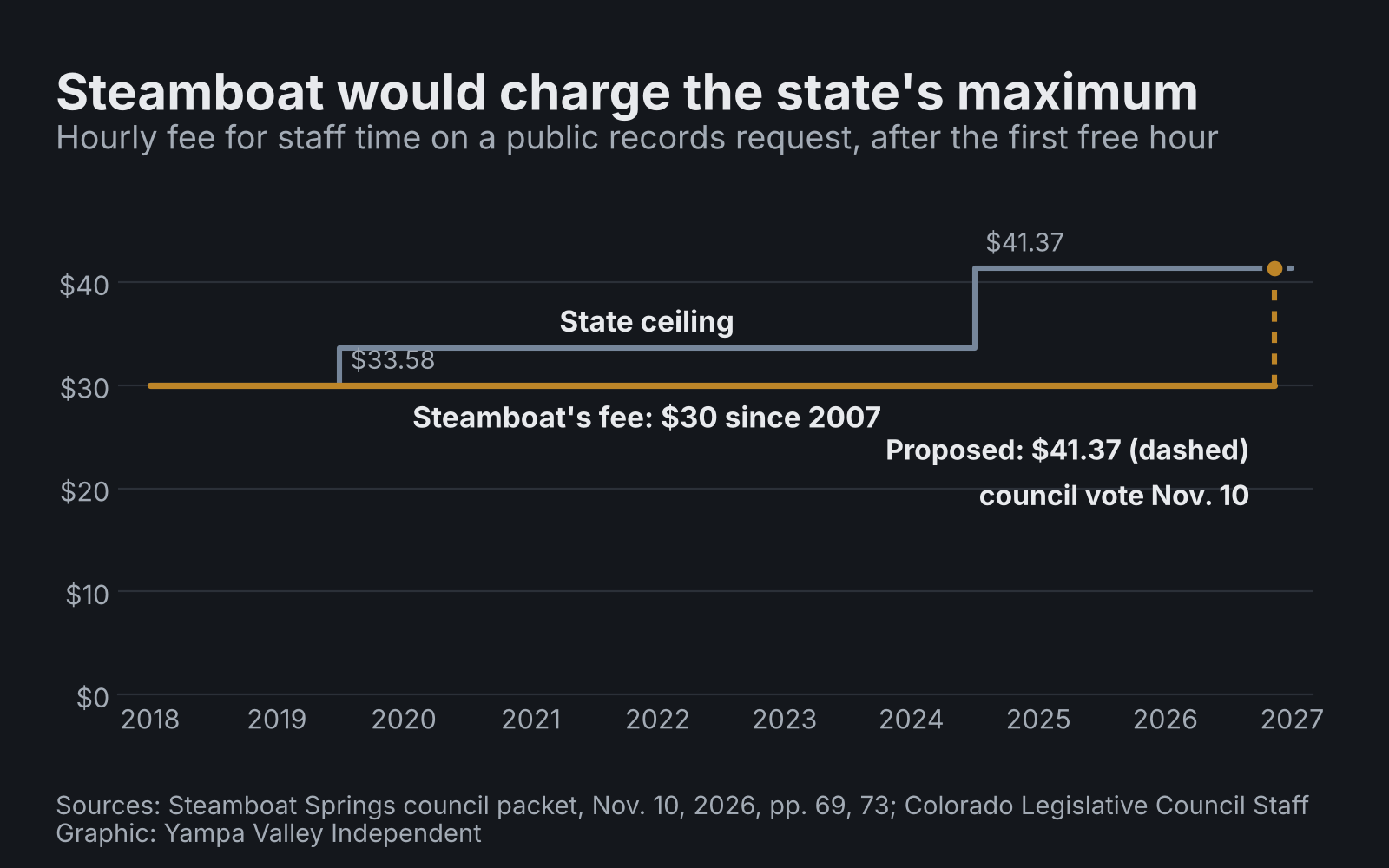
State law sets $41.37 as a ceiling, not a required rate: the fee "shall not exceed this amount." The city has charged $30 since 2007, and the staff memo itself lists keeping $30, or setting some other rate, as options council could choose.
The staff memo and resolution give council no count of how many records requests the city receives, how many staff hours they take or how much money the higher fee would raise. The memo says only that the fiscal impact "will depend on the number and complexity of records requests received."
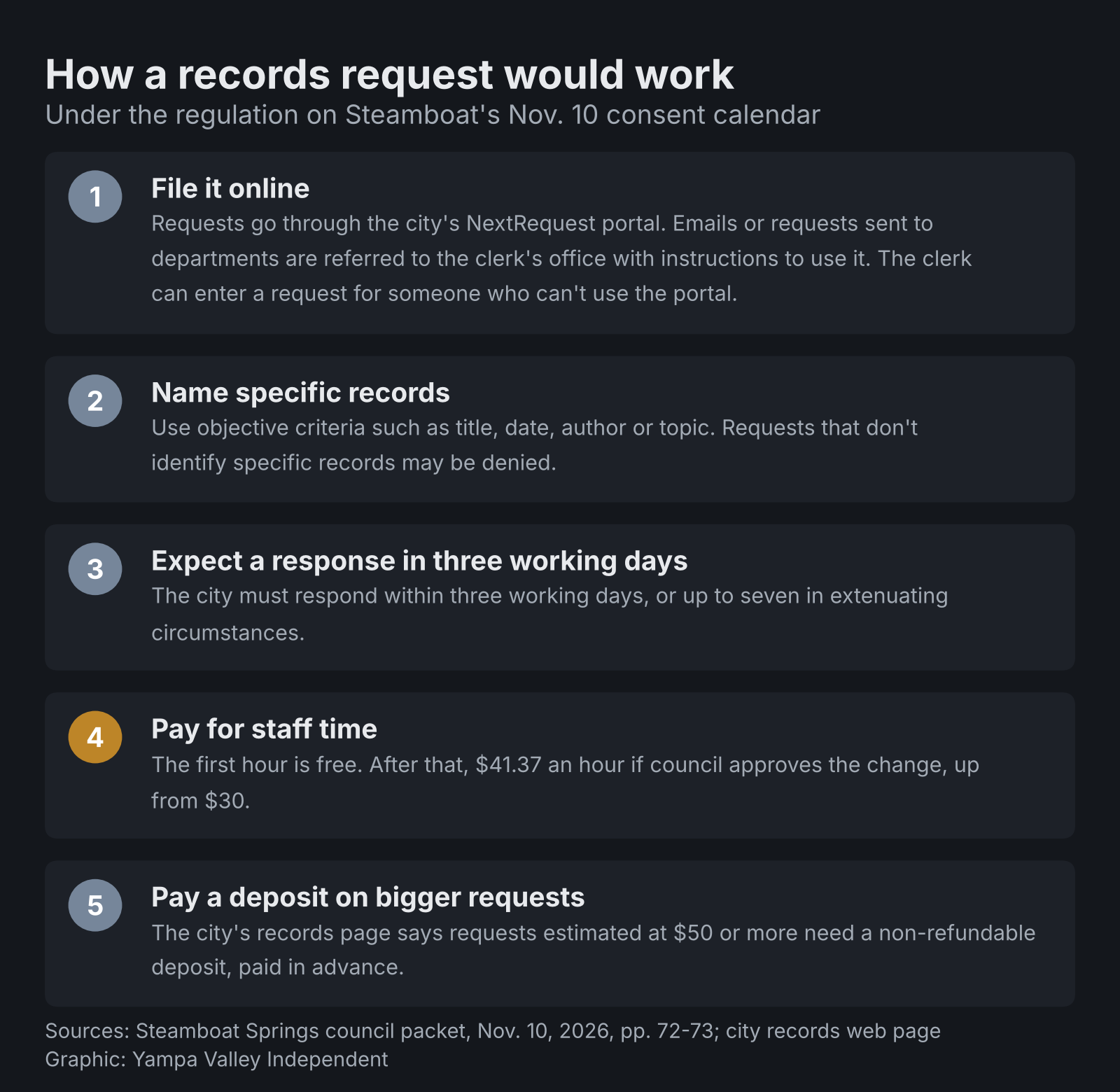
The same resolution writes into city rules what the city's website already tells requesters: requests must go through the city's online portal. It adds that requests sent by email or to individual departments will be referred to the clerk's office with instructions to use the portal. Criminal justice records fall outside the regulation.
What changes
The research-and-retrieval fee, charged for each hour of staff time after the first free hour, would go from $30 to $41.37. That is $11.37 more for every billable hour, a 37.9% increase, by the Independent's calculation.
Under state law, a higher rate can apply only to requests received after the city publishes its new policy. The city's records web page says requests estimated at $50 or more also require a non-refundable deposit, paid in advance.
Under the amended regulation, "All requests for public records shall be made in writing to the custodian through the City's designated online public records request portal." Requests sent by email or directly to departments or employees "will be referred to the City Clerk's Office with instructions to submit the request through" that portal, it says. The clerk's office may enter a request for someone who cannot reasonably use the portal.
The Steamboat Pilot & Today reported in June 2022 that the city would start taking requests through the portal, NextRequest, on June 27 that year. City Clerk Julie Franklin's memo says the resolution "formalizes the use of NextRequest as the City's centralized system for managing public records requests."
The proposed regulation says requests must identify records "using objective criteria such as title, date, author, topic, place of search etc." and that requests "that fail to identify specific records may be denied by the custodian." The packet's copy shows no markup of which wording is new and which carries over from the city's 2016 rules. It keeps a three-working-day deadline for the city to respond, which can stretch to seven working days in extenuating circumstances.
Who pays, and who doesn't
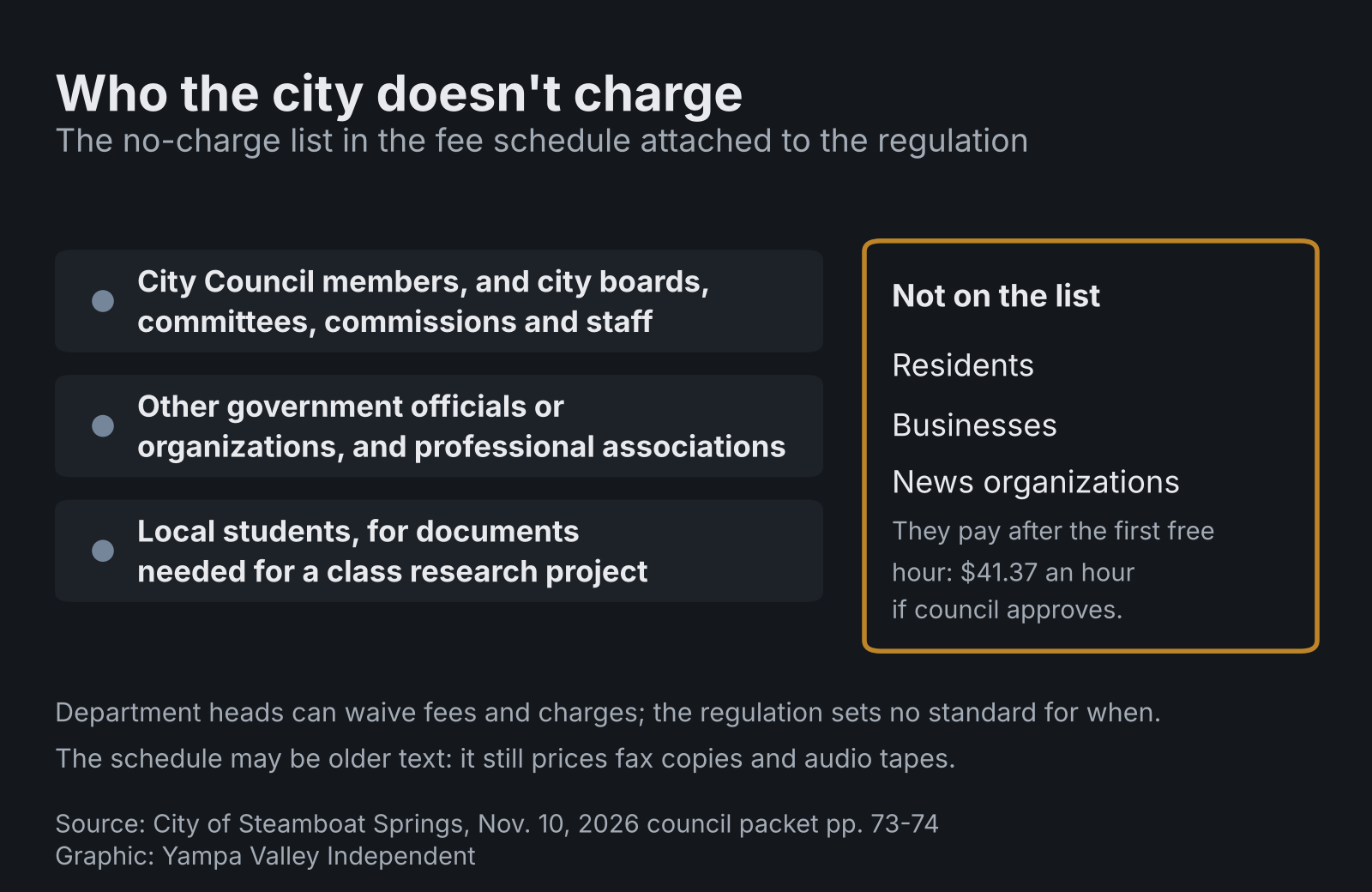
The fee schedule attached to the regulation lists three kinds of requests the city doesn't charge for: those from council members and city boards, committees, commissions or staff; those from "other government officials or organizations or professional associations"; and those from local students working on a class project. Residents, businesses and news organizations aren't on the list. The schedule, which still prices fax copies and "audio tapes/mini discs," may be older text; the packet doesn't show whether any of it is new.
Department heads can waive fees and charges, the regulation says, but it sets no standard for when they should.
A ceiling, not a requirement
Colorado's open records law caps the hourly research fee, and legislative staff adjust the cap for inflation every five years. The cap rose from $30 to $33.58 in 2019 and to $41.37 on July 1, 2024. Steamboat kept charging $30 through both increases, the regulation says, so it has been below the ceiling since 2019.
The city's case
Franklin's memo says state law raised the maximum and that governments "must revise and publish their CORA policies before charging the increased fee." The higher fee "is intended to recover a portion of the staff costs associated with researching and retrieving public records," it says. The regulation itself says the increase "reflects necessary adjustments to administrative costs and maintains the City's continued ability to manage record-related services effectively." State law lets the clerk, as custodian, set "reasonable rules and regulations for the inspection and copying of public records," the memo says.
The resolution says a single online process "promotes consistent, transparent, timely, and efficient processing of requests." The memo says the changes support "the City's commitment to transparency, public access to records and efficient government operation."
Staff recommend adoption.
What the packet doesn't answer
- How many records requests does the city receive, and how much has it collected in research fees?
- Will a request emailed to the city be logged, and when does the response clock start for one that's referred to the portal?
- Which parts of the regulation are new?
- When do department heads waive fees?
Disclosure: The Yampa Valley Independent files public records requests with the City of Steamboat Springs and could pay the new rate on future requests.
What's next
Council meets at 5 p.m. Tuesday, Nov. 10, in the Citizens' Meeting Room at Centennial Hall, 124 10th St., and on Zoom (meeting ID 985 289 877). Any council member or member of the public may ask to pull the item from the consent calendar for discussion before the vote, and spoken comments are limited to three minutes. Written comments go to citycouncil@steamboatsprings.net.