Consultants doubt Slate Creek can make the 2027 ballot. Leaders say: Try anyway.
The project team told the steering committee its schedule now pointed to a 2028 vote. Most members told the consultants to find a faster path, even at the cost of less public input.

Key points
- The team planning Slate Creek told the steering committee Nov. 6 that its schedule now pointed to an annexation vote in 2028, not November 2027.
- Most members told the consultants to bring back a plan for November 2027, with a fallback, accepting less public input. The consultants called that a calculated risk.
- The 2027 date had been in doubt since at least October, and Katzman said the project lost about three months this year while the committee debated its approach.
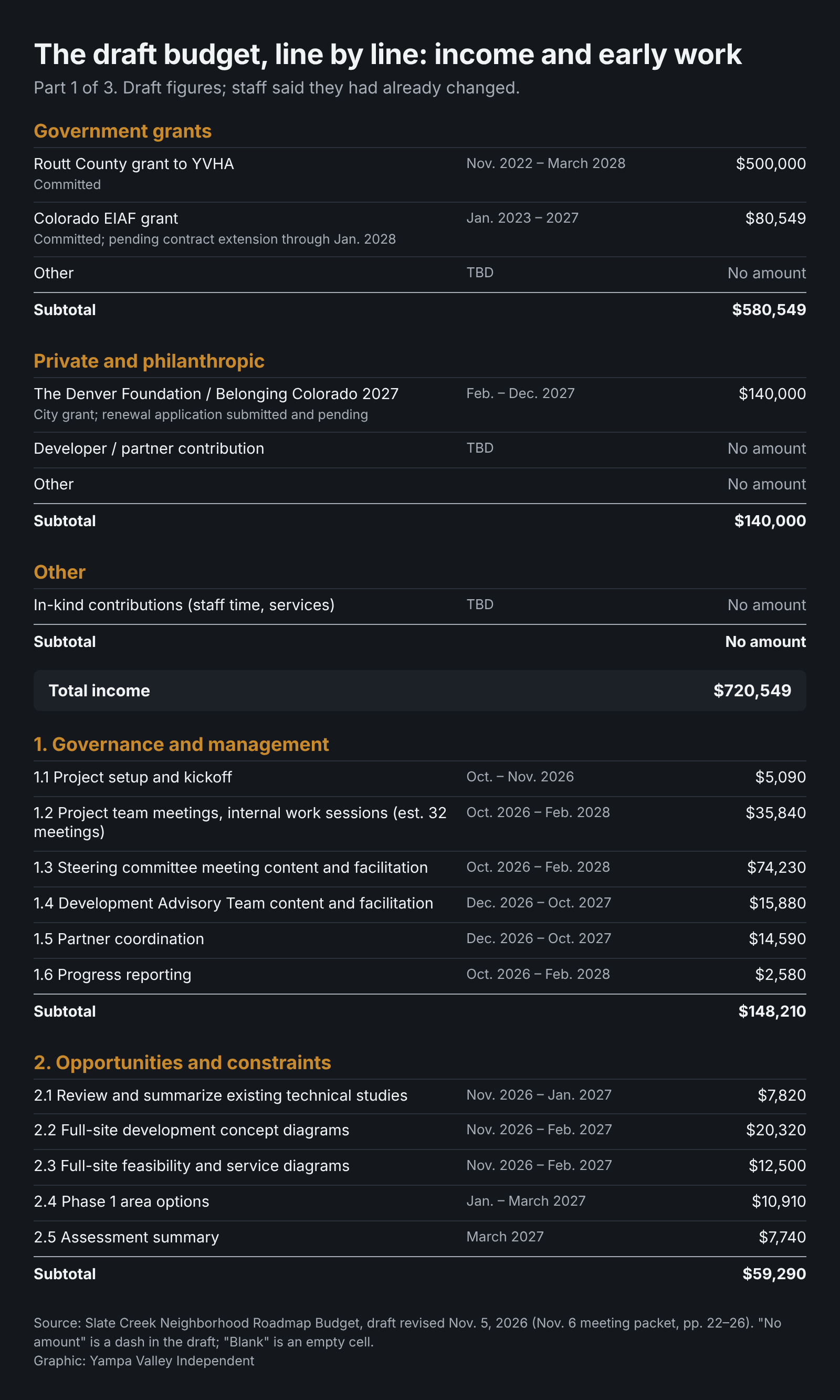
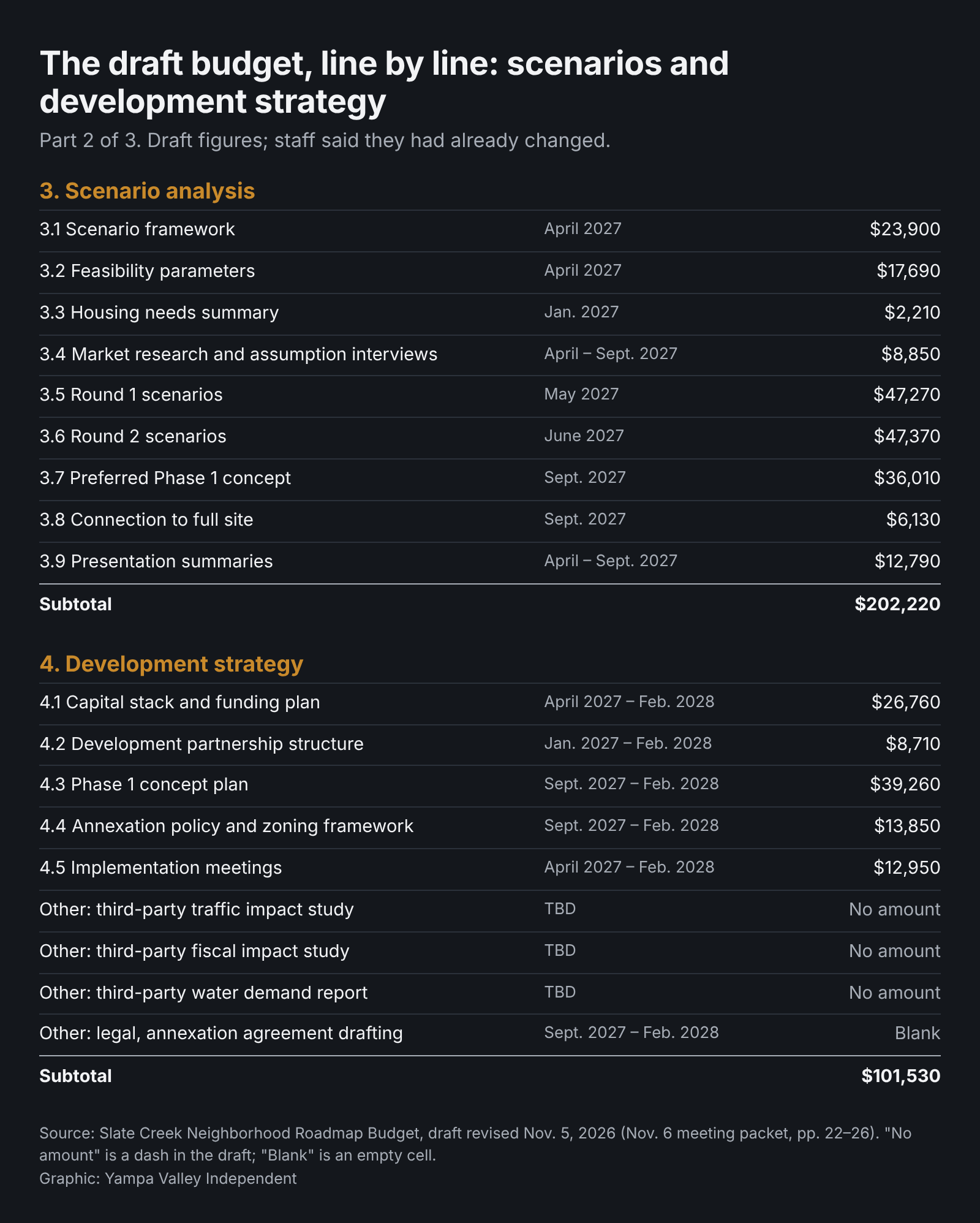
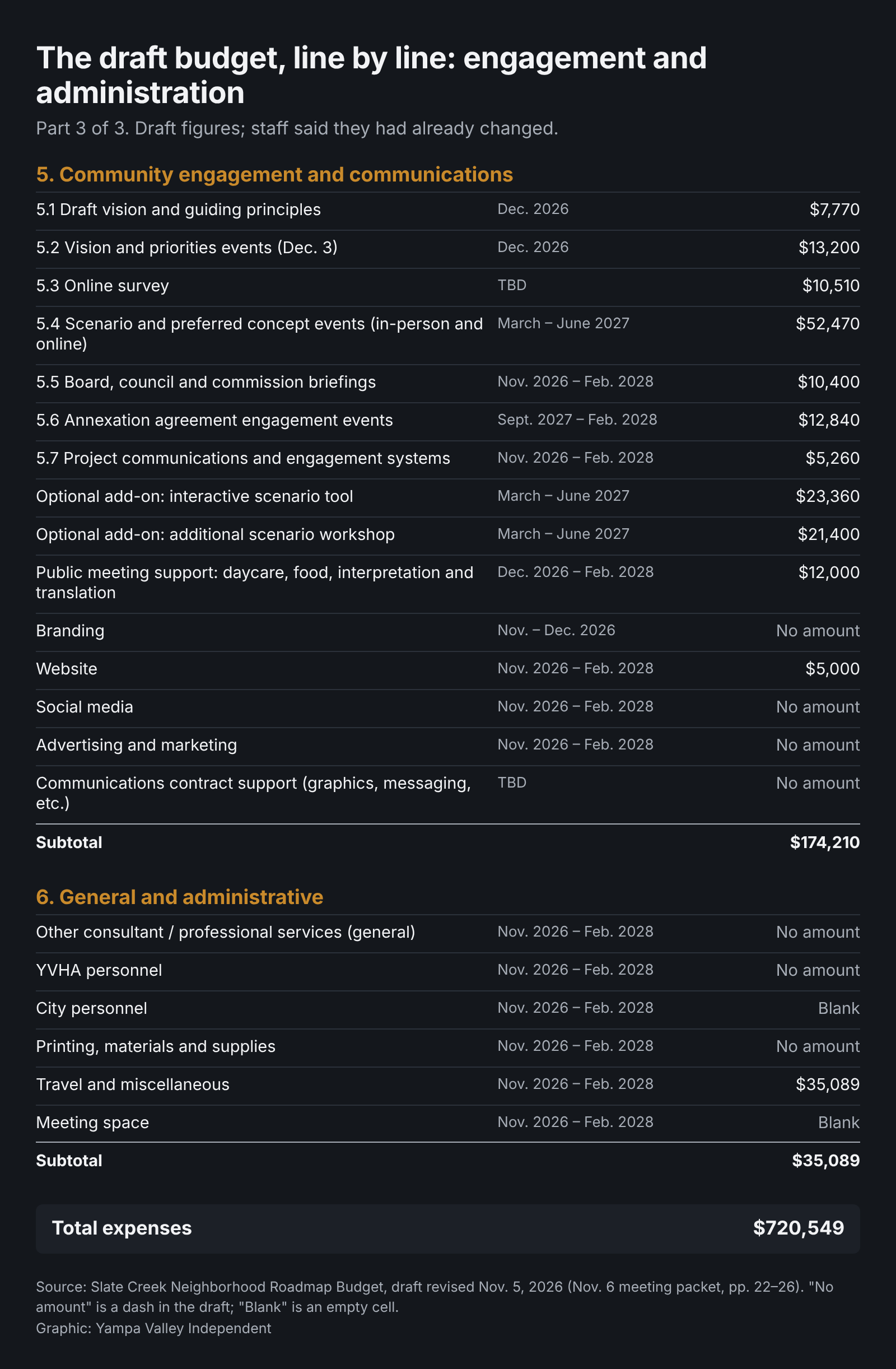
- The draft planning budget is $720,549 through February 2028 and had already changed; outside traffic, fiscal and water studies and annexation legal work have no price, and $140,000 depends on a pending grant renewal.
- City sales, accommodation and short-term rental taxes are running below last year, and the city's 2027 budget, adopted Nov. 10, cuts maintenance. The draft Slate Creek budget lists no amount for a fiscal impact study. Voters rejected a Brown Ranch plan of more than 2,200 homes in 2024.
The team planning Slate Creek, the site formerly known as Brown Ranch, told the project's joint steering committee Nov. 6 that its schedule now pointed to an annexation vote in 2028, not November 2027. After more than an hour of discussion, most committee members told the consultants to come back with a plan to reach 2027 anyway.
Asked when the work would wrap up, lead consultant Alex Joyce of Cascadia Partners said the tentative plan was to finish in time for "the 2028 cycle," according to the meeting video. Asked whether the team could run a broad public process and still make 2027, he said he did not want to "overpromise."
The Yampa Valley Housing Authority manages the project. YVHA Development Project Manager Emily Katzman began the budget update by saying a contract making Cascadia the lead consultant would go to the YVHA board Nov. 12; by the end, she said the revised scope and budget would come later. The draft budget the committee received puts the planning work at $720,549 through February 2028, not counting several items it lists without amounts.
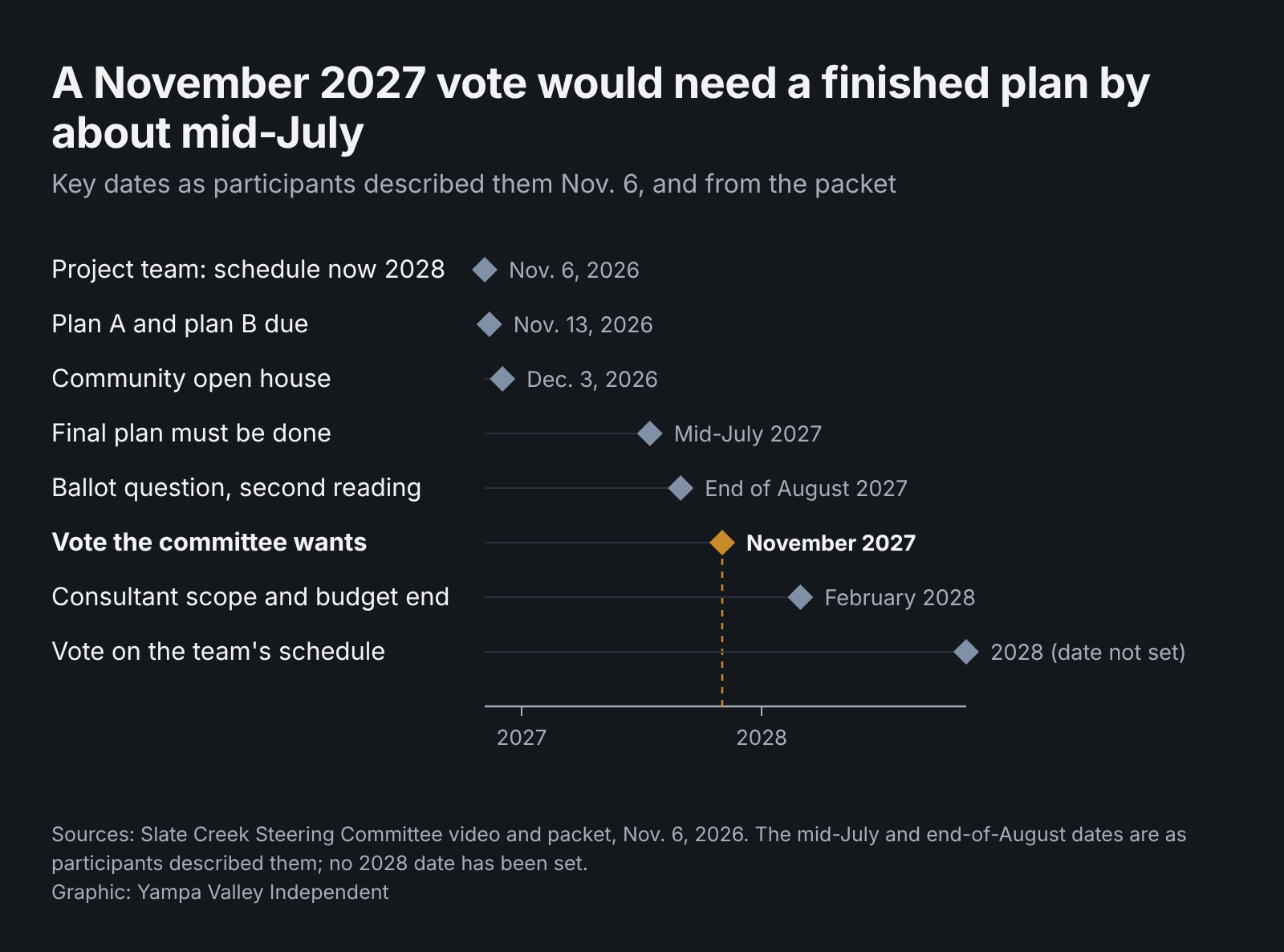
Sources: Nov. 6, 2026 steering committee video and packet · 8 dates. Graphic: Yampa Valley Independent
To make the November 2027 ballot, the final plan has to be finished by about mid-July, participants said at the meeting, so the ballot question can get its second reading by the end of August. Cascadia's scope and budget run through February 2028.
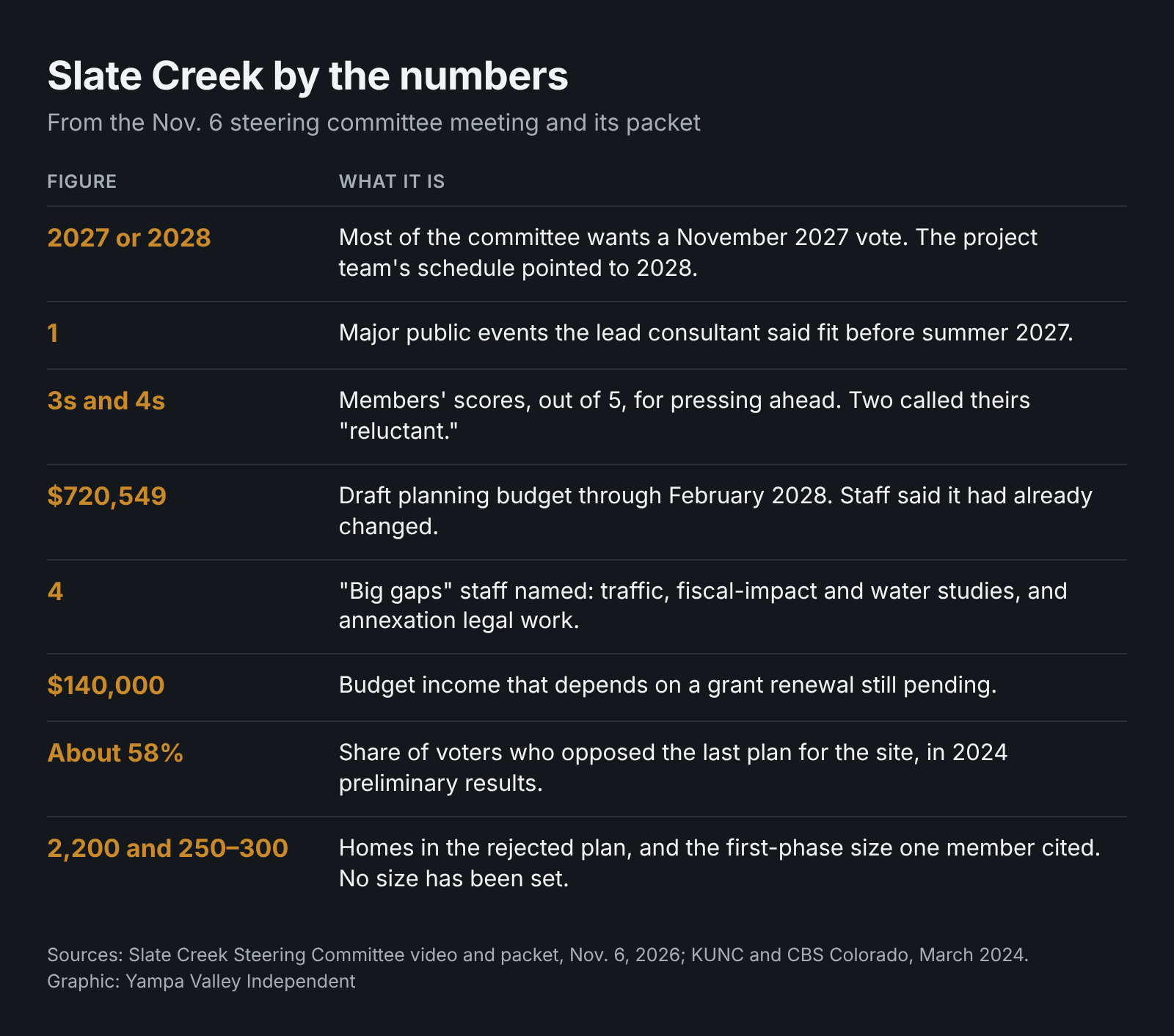
By the numbers
Warnings since October
Warnings about the 2027 date had been on the record for weeks. A YVHA summary of the committee's Oct. 9 meeting, drafted with AI from the transcript and refined by the project team, says Katzman noted that late spring and early summer 2027 were "very tight" and that the team would keep evaluating whether the vote "remains realistic." The same summary says the group affirmed the fall 2027 timeline. On Nov. 6, a consultant reminded members, "we did talk about this in the last meeting." Katzman said the project "lost about three months this year" while the committee paused to debate its approach.
Even so, one member said that "saying we're now looking at 2028 is news and nothing that we have vetted with any of our boards." Another noted that the roadmap in the meeting packet showed the annexation agreement done in July 2027; the reply was that it "needs to be updated."
Katzman said she was "taking some ownership" of the change. Finishing in 2027 would have allowed "one community engagement event which I personally do not think is sufficient to build community support to get a successful vote," she said, so she "made the call" to plan for more. "If I got it wrong and we need to redirect, we can do that," she said.
Most members: try anyway
Most members wanted to keep 2027. One said he was "starting to get angry," because he thought the committee had agreed not to "simply go out into the community and ask everybody in the universe what they wanted." Facilitator Bill Fulton of The Civic Canopy summed up most of the room as "highly committed" to the November 2027 ballot.
Members asked the consultants for a plan that reaches it with as much community engagement as fits. Joyce agreed to bring one Nov. 13, with a "plan B" to fall back on.
The agenda allowed no motions but let members give direction to staff and the consultant team. In a fist-to-five vote, the committee's method for reaching consensus, all eight people polled scored the direction 3 or 4. YVHA board member Shannon Doin-Landers, who had said she was "personally fine with the 28 timeline" and would "rather take our time and do it well," and Katzman each called theirs a "reluctant three."
Joyce said the team was "game for either one" but called the faster path "a calculated risk." One told the committee, "we don't necessarily agree with it as the right approach," but that the team would try its best.
Members also raised a special election as a fallback, a possible YVHA property tax renewal on the same 2027 ballot, and whether a project this size needs a public vote at all. None of those was decided.
What the public could lose
Joyce said a 2027 timeline would limit the team "realistically to one major public event" plus targeted stakeholder meetings before summer 2027. He later told members not to get "too fixated on the single large event," but said the scale of public engagement would probably have to shrink. Fulton's summary described the trade as asking the community "to respond to options in a single large event rather than shape those over multiple events," with the committee accepting "the risk on less engagement and potentially less support."
Katzman said meeting the date would probably mean "not doing scenario planning," adding that she had not yet discussed that with the consultants. In scenario planning, the team models several versions of a first phase so residents can weigh the trade-offs. A consultant answered that he "would be cautious about tossing out the scenario work entirely."
A budget with blanks
The committee also got a five-page draft budget, marked "Revised 11-5-26," that Katzman said was "the best information I had as of yesterday and it's already changed." She said it is the overall project budget and includes costs outside Cascadia's contract; the base budget in the contract's newest version was "a little under $665,000," members were told. YVHA's board approves that contract with a not-to-exceed amount, Katzman said, and how that "interacts with the steering committee is less clear to me." Fulton told members it is "the purview of the steering committee" to determine the roadmap budget.
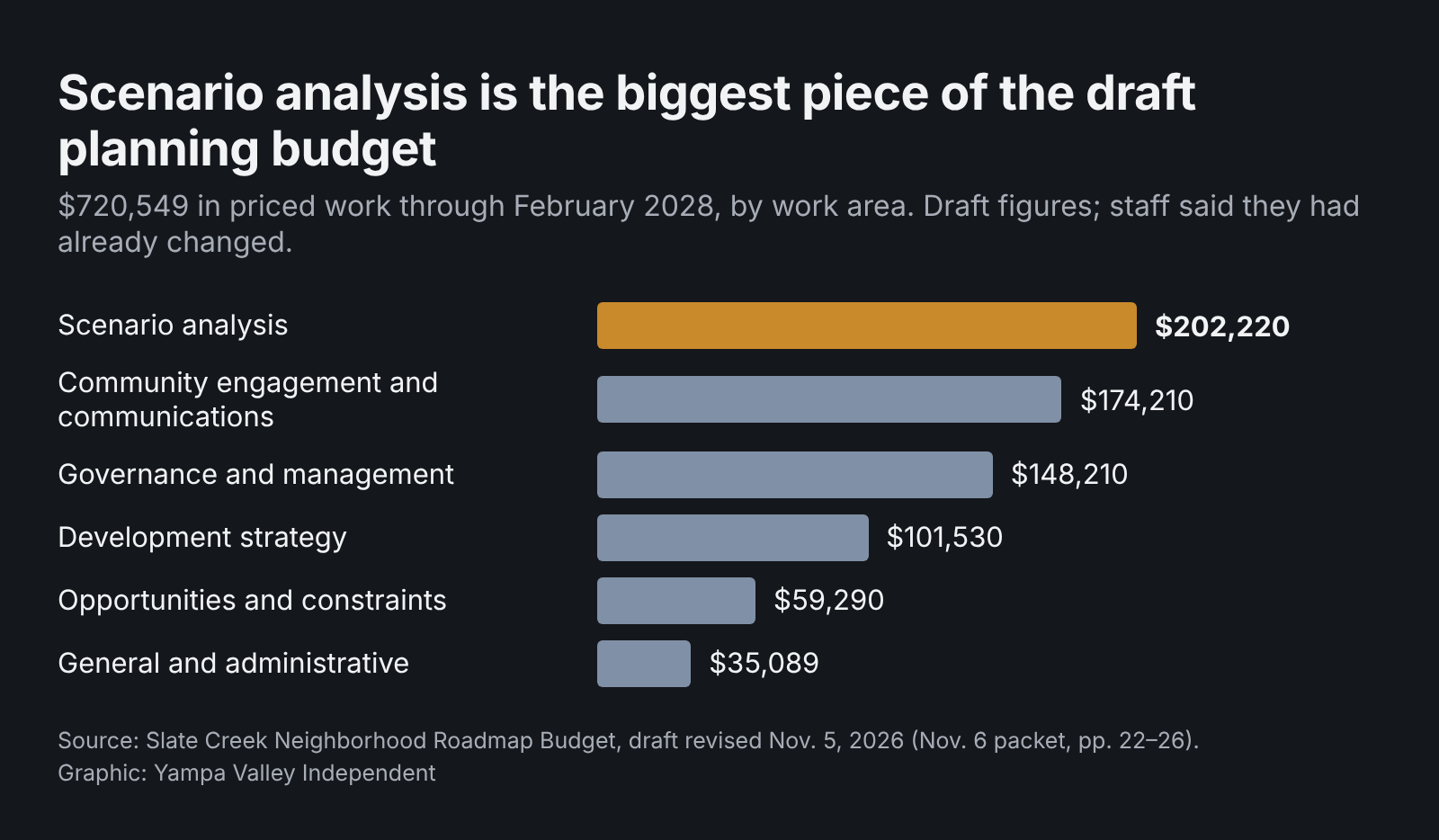
Source: Slate Creek Neighborhood Roadmap Budget, draft revised Nov. 5, 2026 (Nov. 6 packet, pp. 22–26). Graphic: Yampa Valley Independent
Scenario analysis is the largest work area in the draft.
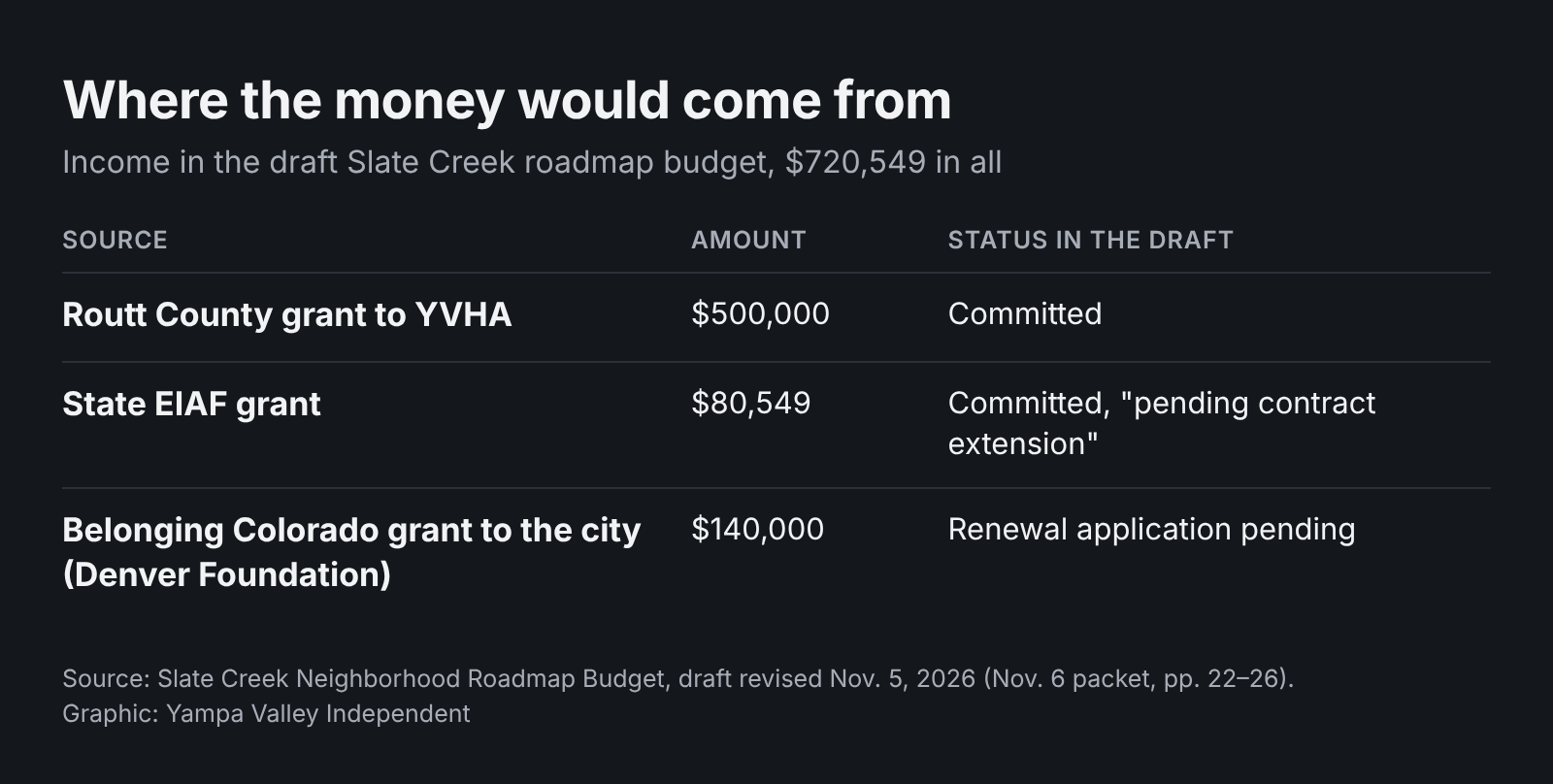
The pending grant is about 19% of the income, by the Independent's calculation. The renewal did not come up at the meeting.
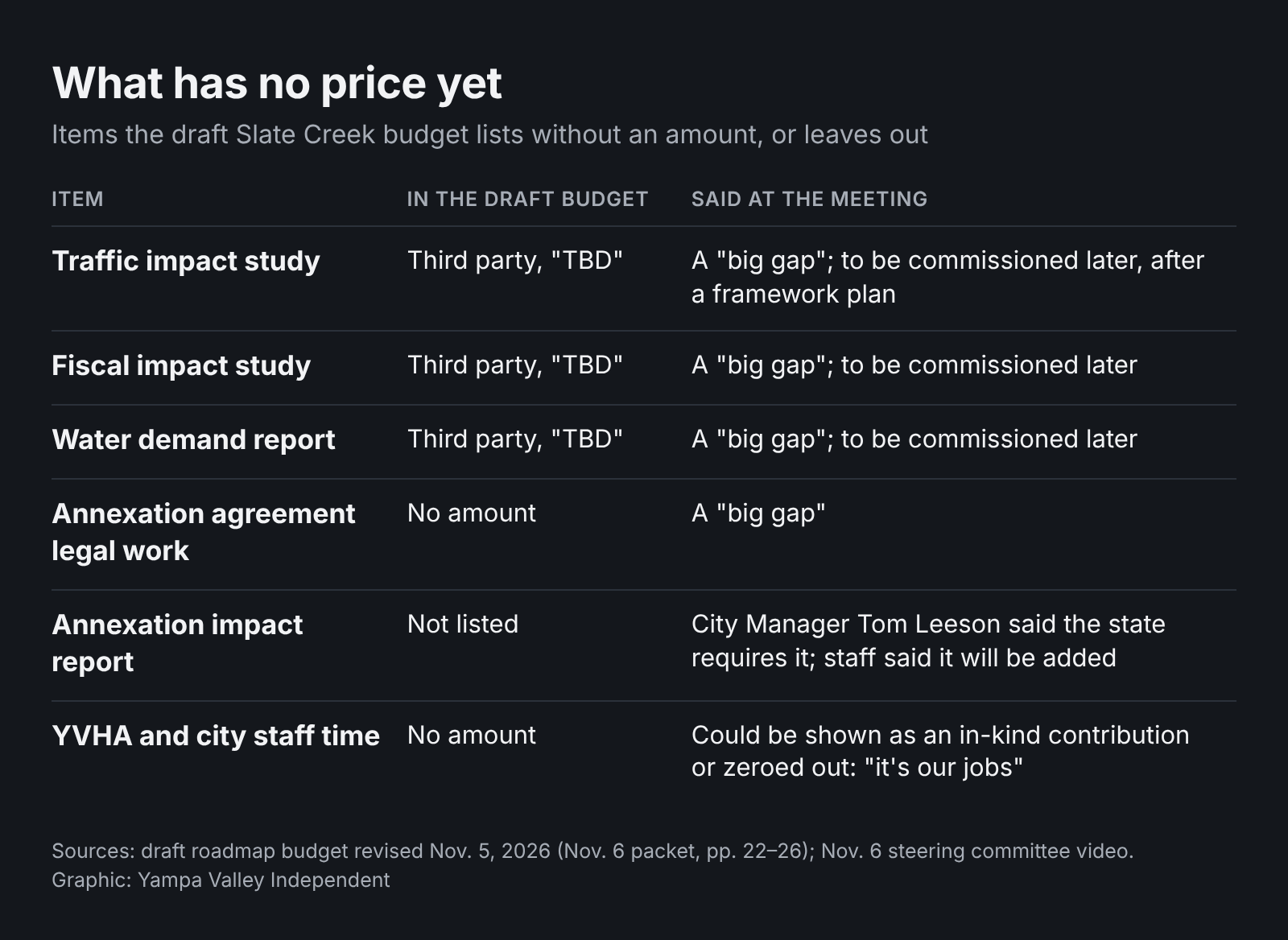
Katzman said the money could come from YVHA's own funds, more of the state grant or a conversation with the city.
What consultants would be paid, and what outreach would cost
Cascadia is the prime consultant, with three other firms as subcontractors, and Katzman put the base budget in its contract at "a little under $665,000." The draft does not show what each firm would be paid. Its largest single line is $74,230 for preparing and facilitating steering committee meetings. Another $35,840 covers an estimated 32 project team meetings and internal work sessions, about $1,120 each by the Independent's calculation.
Public events are budgeted at $13,200 for the Dec. 3 vision events, $52,470 for scenario and concept events in spring 2027 and $12,840 for annexation agreement events. The engagement total also counts two items labeled optional add-ons, a $23,360 interactive scenario tool and a $21,400 additional scenario workshop, along with $12,000 for daycare, food and interpretation at public meetings. In all, the draft puts $174,210 toward community engagement and communications. Katzman tied that work to the ballot: one event, she said, is not "sufficient to build community support to get a successful vote." The draft also lists branding, social media, advertising and marketing, and communications contract support, each without an amount. The largest source of the money is a $500,000 Routt County grant.
The only general and administrative cost with an amount is $35,089 for "travel & miscellaneous." Government grants supply $580,549 of the $720,549, about 81% by the Independent's calculation.
The draft schedules annexation agreement legal drafting and engagement events for September 2027 through February 2028. That is after the mid-July date participants gave for finishing a plan in time for the November 2027 ballot.
Every line of the draft budget is listed at the end of this story.
Why the timing matters
The last plan for the site failed at the ballot. In a March 2024 special election, about 58% of voters opposed annexing Brown Ranch, according to preliminary results reported by KUNC. An opposition leader told CBS Colorado the plan was "much too big" and said "the big question is where is the money coming from." On Nov. 6, one member called that plan's size the "biggest reason" it failed.
The vote would come as city tax collections run below last year. City sales and accommodation taxes are down, and the city's 2027 budget, adopted Nov. 10, cuts maintenance. The short-term rental tax that voters dedicated to housing is down 9.2% through September. The draft Slate Creek budget lists no amount for a fiscal impact study; Katzman said it would be commissioned later and could be added to Cascadia's contract or done by another firm. One participant said Nov. 6 that a municipal services analysis shows a project kept within 400 units would not bring the added city costs the last plan did; the Independent has not reviewed that analysis. Not every local measure is down: jobs in early 2026 were about even with a year earlier, and home prices are little changed.
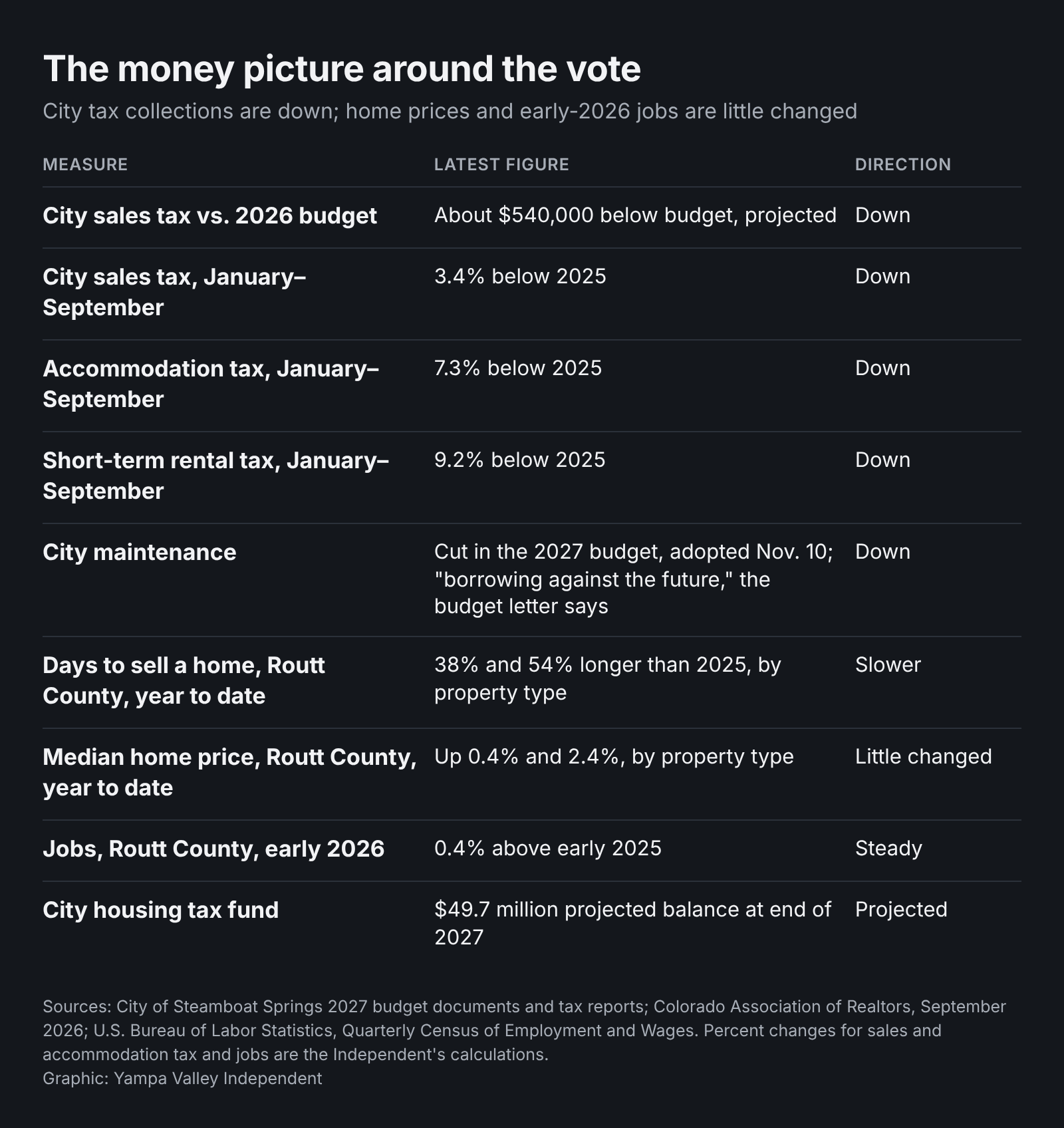
That fund comes from the short-term rental tax voters approved in 2022 for affordable housing "at locations including, but not limited to, brown ranch." The projection assumes no 2027 spending; the city's finance director has called the figure "not correct" because the council will approve projects during the year. At the city's October budget retreat, Council Member Gail Garey, who also sits on the steering committee, listed Slate Creek among the fund's possible 2027 costs. Percent changes in the table for sales and accommodation tax and for jobs are the Independent's calculations from city and federal figures.
Disclosure: Michael McLarney, the Independent's owner and editor, is married to Emily McLarney, who serves on the City of Steamboat Springs' Ad Hoc Housing Advisory Committee, which reviews requests for short-term rental tax money.
The committee's case
The committee's stated purpose is to "create a path for Slate Creek Neighborhood by providing homes for our community, prioritizing affordability, feasibility, and community support." Members argued Nov. 6 that a smaller first phase, whose size has not been set, answers the objections to the last plan, that extensive engagement has already been done, that the annexation agreement can carry fewer details, and that the date can still slip if the plan runs into resistance, according to Fulton's summary. They asked for the most public engagement the schedule allows. In October, they limited the annexation plan to a first phase rather than all 420 acres inside the urban growth boundary.
Open questions
- When did the project team conclude November 2027 was out of reach, and how was that conveyed to the committee and its three boards?
- What public input would be cut to reach November 2027, and what is plan B?
- Will the steering committee see the revised scope, budget and Cascadia contract before YVHA's board votes on them?
- What will the unpriced studies and legal work cost, and what happens if the $140,000 grant isn't renewed?
What's next
The city posted a video of the Nov. 6 meeting, 2 hours and 12 minutes long, on its YouTube channel and the EngageSteamboat.net Slate Creek page on Nov. 10. Quotes from the Nov. 6 meeting were taken from the video's captions and checked against the recording.
The Nov. 6 agenda called it a working meeting with no public comment. Comments can go to City Council at citycouncil@steamboatsprings.net, the county commissioners at bcc@co.routt.co.us, or YVHA at inquiry@yvha.org.
- Nov. 12: YVHA's board meets. Katzman first said it would take up the Cascadia contract, then said the revised scope and budget would come later.
- Nov. 13: The steering committee meets again; Joyce is to bring a plan aimed at November 2027.
- Dec. 3: A meeting with the Deliberation and Stewardship Team, 3:30 to 5:30 p.m., then a community open house, 6 to 8 p.m.; no location has been announced.
- Dec. 4: The steering committee is to approve the advisory team roster.
The draft budget, line by line
Every line of the draft Slate Creek Neighborhood Roadmap Budget, marked "Revised 11-5-26," as presented to the steering committee Nov. 6. "No amount" is a dash in the draft; "Blank" is an empty cell. Katzman said the figures had already changed.