
After inflation, Steamboat's sales tax is running at its lowest since 2021 as the resort delays opening day
Through September, collections were 6.6% below last year after inflation and nearly 8% below 2022. Routt County has about as many private-sector jobs as in 2007, and nearly half of this year's tax drop came in a record-warm March.


Climate and Steamboat's economy, Part 2
Key points
- Steamboat Resort has moved its opening day to Friday, Nov. 27, saying temperatures haven't been consistently cold enough for snowmaking.
- After inflation, city sales tax collections through September were 6.6% below the same months of 2025 and nearly 8% below 2022, lower than any year since 2021, when the ski season ran under COVID-19 restrictions. As collected, before inflation, they were down 3.4%.
- Nearly half of this year's drop in collections came in March, Routt County's warmest in 132 years of records. Paid lodging occupancy fell 17% that month, according to the Steamboat Springs Chamber.
- Routt County had 13,804 private-sector jobs in 2025, about as many as in 2007, while Colorado's grew 26%. About 59% of them are in resort-tied industries, compared with 35% statewide.
- The city gets 60% to 67% of its General Fund revenue from sales tax, according to a July city memo.
Steamboat Resort said Tuesday that it has pushed its opening day back to Friday, Nov. 27, because "temperatures have not been consistently cold enough to support snowmaking operations at the level needed." The resort had been scheduled to open Saturday, Nov. 21.
The delay comes as the General Fund's biggest source of revenue is shrinking once inflation is counted. Through September, Steamboat collected $31,744,086 in sales tax, 3.4% less than in the same months of 2025, according to the city's preliminary September tax report, released Nov. 2. After adjusting for inflation, the drop is 6.6%, by the Independent's calculation using the federal Consumer Price Index.
Measured in 2026 dollars, January through September collections were about $31.7 million this year, nearly 8% below the same months of 2022, the high point after inflation, and lower than any year since 2021, when the 2020-21 ski season ran under COVID-19 restrictions, by the Independent's calculation. Before inflation, this year's total looks higher than 2022's.

That matters for city services. The General Fund "is heavily reliant on sales tax, with 60-67% of revenue coming from sales tax annually," Finance Director Kim Weber wrote in a July 14 memo to the City Council. The memo repeated the council's problem statement: "our current level of services have outpaced our revenue."
Private jobs, about where they were in 2007
Routt County had 13,804 private-sector jobs in 2025, according to the federal Quarterly Census of Employment and Wages. That's 73 more than in 2007, an increase of 0.5%. Over the same 18 years, private-sector jobs grew 26% in Colorado and 17% nationwide, by the Independent's calculation.
2007 was the county's high point before the recession. Private jobs fell to 11,081 by 2010 and didn't pass the 2007 level until 2024, by the Independent's calculation.
Private jobs in the county fell 0.8% in 2025, the first annual drop since 2020, while Colorado's fell 0.1% and the nation's rose 0.5%, by the Independent's calculation.

Construction accounts for much of the flat line: the county had 1,343 fewer private construction jobs in 2025 than in 2007, while arts and recreation added 478 and lodging and food 255, by the Independent's calculation.
About 59% of the county's private jobs are in industries tied to the resort economy: lodging and food, arts and recreation, retail, real estate and construction. Statewide, those industries hold 35% of private jobs, by the Independent's calculation.
The federal count covers jobs that employers report for unemployment insurance; it leaves out proprietors and the unincorporated self-employed.
Where this year's drop came from
The city's Mountain tax area accounts for most of this year's drop. Through September, its collections were $817,922, or 12.1%, below 2025, according to the September report. Lodging businesses citywide paid $702,814, or 9.6%, less, while collections in the area the report labels Out of Town rose $537,088, or 13.1%.
Nearly half of the year's drop came in a single month: last March, the warmest in 132 years of Routt County records. On the September report's figures, March collections were about $4.85 million, about $550,000 below March 2025, by the Independent's calculation.
The city's final March report had put March collections at $4,802,278, $592,701 less than in March 2025, a drop of 10.99%; the city's later reports include late payments.
March is one of the city's biggest months for sales tax. In 2025, it brought in $5,394,979, more than any other month, according to the city's tax reports.
A record-warm, near-record-dry March
Routt County averaged 39.5 degrees in March 2026, according to NOAA's county records. By the Independent's calculation from those records, that beat the previous March record, set in 2017, by 1.8 degrees, and was 8.9 degrees above the March average for 1996-2025. It was also the county's second-driest March on record, with 0.72 inch of precipitation; only 1910 was drier.
Around Steamboat, the snowpack usually keeps building through March, according to the Independent's analysis of federal snow records. Last March, it shrank.
At the Dry Lake snow station, at 8,240 feet about 4 miles northeast of downtown, the snowpack lost 10.2 inches of water during March, by the Independent's calculation from Natural Resources Conservation Service records. In a typical March, it gains 2.8 inches. The snowpack at the station had melted out by April 10, 39 days earlier than the median and 12 days earlier than in any other year since 1981.

Higher up, at Rabbit Ears (9,390 feet) and Tower (10,610 feet), the snowpack also shrank more in March than in any year on record, and all three stations had their lowest April 1 snowpack on record, by the same calculation. At Tower, it was the first March in 47 years of records in which the snowpack shrank at all.
Steamboat Resort moved up its closing day twice. It had planned to close April 19, changed that to April 12 on March 17, and on March 29 announced it would close April 5, according to Steamboat Radio, which published the resort's March 29 media alert. "Due to the limited snow in the base area," the alert said, the resort's Cardboard Classic would not take place.
Where the money fell
The city's report breaks down collections by area and by type of business. In the city's Mountain tax area, collections for March fell $413,991, or 21.6%, from a year earlier. For April, Mountain area collections were 40% lower than for April 2025.
Lodging businesses citywide paid $366,086, or 20%, less sales tax for March than a year earlier. Restaurants paid 13.6% less and sporting goods stores 19.1% less, while grocery stores paid 1.9% less.
A few parts of the report rose. Miscellaneous retail collections were up 1.3% and the construction category 4%, and the area the report labels Out of Town was up 17%.
The city's separate accommodations tax fell 18.17% in March, and its short-term rental tax fell 19.63%, the report shows.
The Steamboat Springs Chamber, in its monthly data report, called March "a challenging month for visitation in Steamboat Springs, mainly due to historically low snowfall." Paid lodging occupancy averaged 50% in March, down 17% from a year earlier, after drops of 8% in January and 7% in February, according to the report, which cites lodging data from Key Data.
Down in ski towns, up statewide
Retail sales fell from March 2025 to March 2026 in all nine Colorado ski resort areas the Independent compared, from 4.1% around Crested Butte to 17% in Breckenridge, by the Independent's calculation from Colorado Department of Revenue data. Statewide, retail sales rose 0.7%, before adjusting for inflation.
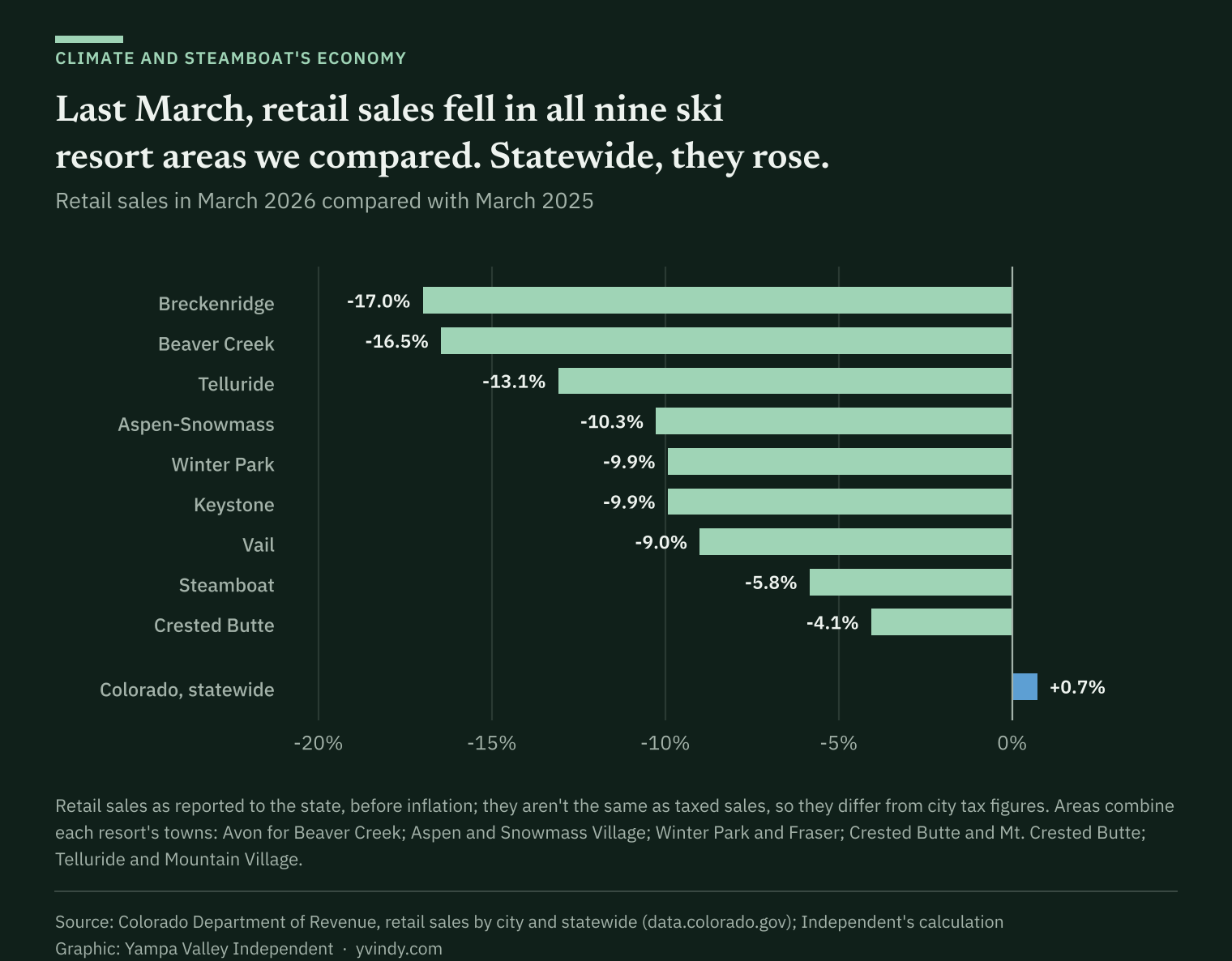
The state's figures measure retail sales, not the tax a city collects, so they don't match the city's report. They show Steamboat's retail sales down 5.8% in March, the second-smallest drop of the nine.
The month that has warmed the most
March is also the month that has warmed the most in Routt County. In Part 1 of this series, the Independent found that March averaged 4.6 degrees warmer in 1996-2025 than in 1951-1980, more than any other month.
What the records can't say
The records show what happened in one March and in this year's collections. On their own, they can't separate the weather from everything else that shapes a ski season, such as prices, pass sales and the national economy, and they don't explain why private job counts have barely grown since 2007. The Chamber attributes the March drop in visitors mainly to low snowfall.
Whether Marches like the last one will become more common is a question for climate scientists. The Independent has asked the Colorado Climate Center at Colorado State University about last winter and how often such winters may occur, and will update this story with any reply.
What's next
- Steamboat Resort's new opening day is Friday, Nov. 27.
- The Independent will update this story if the Colorado Climate Center responds.
How we did this
Sales tax totals through September are from the City of Steamboat Springs' preliminary September 2026 tax report; earlier years' January-September totals are the labels on that report's year-to-date chart, rounded to $0.1 million. Monthly sales, lodging and short-term rental taxes are from the city's final monthly reports for December 2025 through April 2026; each covers tax on that month's sales, remitted to the city the following month; the city's later reports revise monthly figures slightly as late payments arrive. Inflation adjustments use the U.S. Bureau of Labor Statistics Consumer Price Index for All Urban Consumers (U.S. city average); January-September figures use the average of those nine months. Jobs are annual averages from the Bureau of Labor Statistics' Quarterly Census of Employment and Wages; resort-tied industries are arts and recreation, lodging and food, retail, real estate and construction. Temperature and precipitation are from NOAA's National Centers for Environmental Information, Routt County monthly series. Snowpack is from Natural Resources Conservation Service SNOTEL daily records at Dry Lake, Rabbit Ears and Tower; a station's March change is its April 1 snow water minus its March 1 snow water, a typical March is the median of its other years, and melt-out is the first day after the season's peak with 0.05 inch of snow water or less. Complete records begin with the 1979-80 winter at Tower, 1980-81 at Dry Lake and 1986-87 at Rabbit Ears. Occupancy is from the Steamboat Springs Chamber's March 2026 data report. Retail sales by town are from the Colorado Department of Revenue; the nine resort areas combine Steamboat Springs; Vail; Avon (Beaver Creek); Breckenridge; Keystone; Aspen and Snowmass Village; Winter Park and Fraser; Crested Butte and Mount Crested Butte; and Telluride and Mountain Village. Totals, percentages, ranks and medians are the Independent's simple arithmetic on the published figures.