
No defined terms for developers, just pitches: Nearly 4 years in, applicants seek Steamboat's $48 million housing tax one idea at a time
The Independent found no published per-unit offer for builders. Requests are weighed as they arrive, and terms are worked out project by project. Council is tentatively scheduled to take up a new process Dec. 8.

Key points
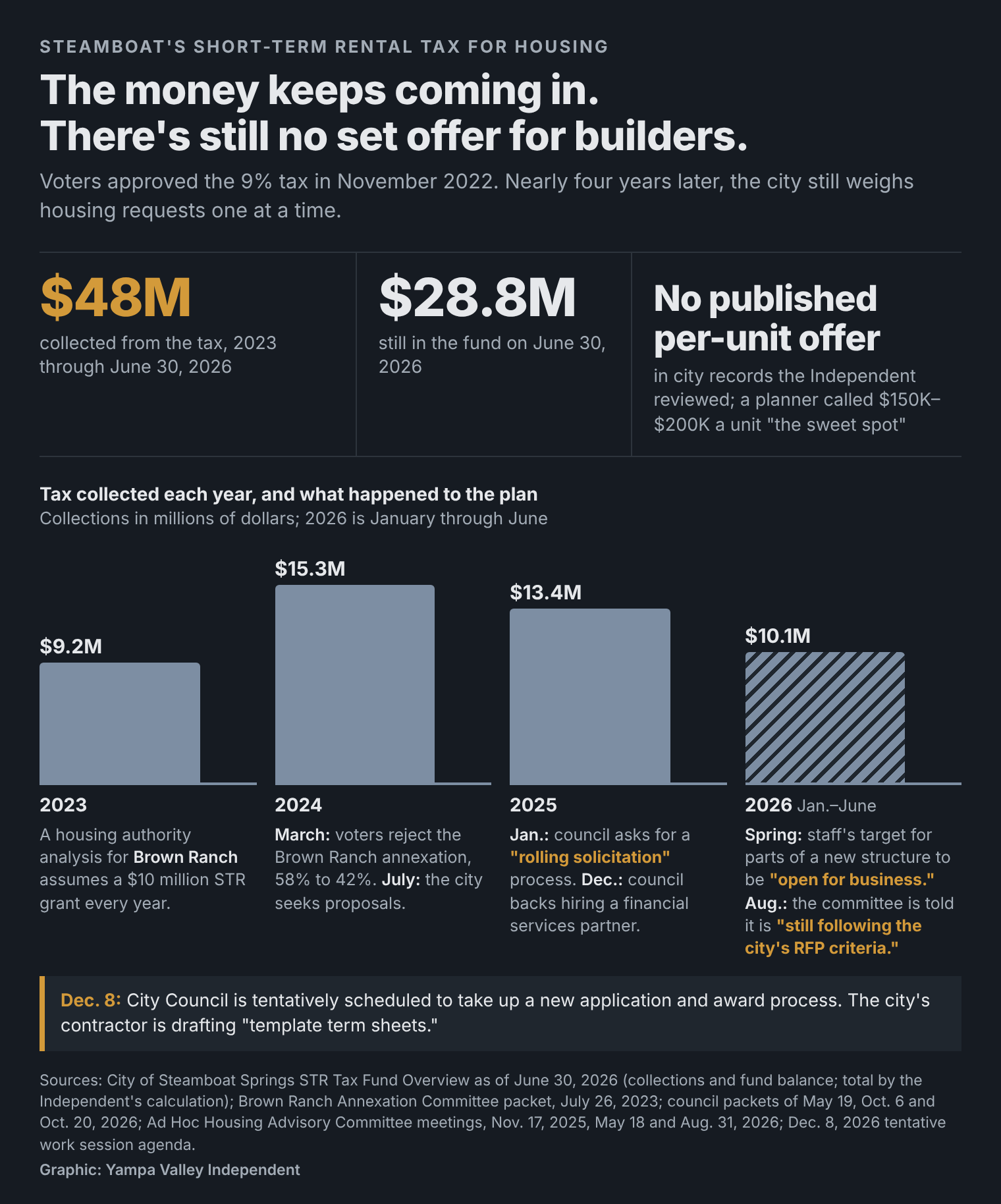
- Steamboat Springs voters approved a 9% tax on short-term rentals in November 2022 for "incentives and contributions" toward affordable housing. Through June 30 it had brought in $48 million, by the Independent's calculation, and $28.8 million was in the fund.
- Builders still bring proposals one at a time. Staff tell applicants to follow a 2024 request for proposals, but the Independent found no published per-unit amount in the records it reviewed. A city planner said in May that requests generally run $150,000 to $200,000 per unit.
- Council asked for a "rolling solicitation" process in January 2025. The planner called an advertised base subsidy his priority for the third quarter of 2025, and staff aimed to have parts of a new structure "open for business" by spring 2026. Council has not yet approved one.
- Council is tentatively scheduled to take up a new application and award process Dec. 8. The city's contractor, CHAI, is drafting "template term sheets."
- The city hasn't answered questions the Independent emailed Oct. 26, including a request for a copy of its CHAI contract.
STEAMBOAT SPRINGS — Nearly four years after Steamboat Springs voters approved a tax on short-term rentals to spur affordable housing, the city still has no published offer telling builders how much help they can get.
Instead, builders bring proposals, and the city weighs them as they arrive. "Proposal comes in; I tell applicants to follow the RFP in terms of what they submit to the City," Principal Planner Brad Calvert, who then staffed the city's Ad Hoc Housing Advisory Committee, told its volunteers in November 2025, according to the minutes. He was referring to the request for proposals the city issued in 2024. If the two council members on the housing subcommittee see promise, the committee evaluates the request. Staff and the subcommittee then work out deal terms, which the city's lawyers draft, and council decides whether to appropriate money.
On Aug. 31, Gates Gooding, who took over staffing the committee, called one application "unsolicited" and said it came "under the city's kind of ad hoc process." The city's new contractor would "formalize this process," he said. "But for now, we are still following the city's RFP criteria."
The tax had brought in $48 million through June 30, by the Independent's calculation from the city's tracking sheet. The city had recorded $24.8 million in spending and held $28.8 million, a balance that also reflects about $2.9 million in investment income and a $2.7 million loan repayment. It projects $49.7 million at the end of 2027, "pending budget appropriations related to other housing initiatives."
Council directed staff in January 2025 to develop a "rolling solicitation" process to invite and judge requests for the money. It is tentatively scheduled to take up the "STR Tax Fund Application and Award Process – Follow Up" at a Dec. 8 work session, 23 months later by the Independent's calculation. The city's contractor, the Colorado Housing Accelerator Initiative, or CHAI, "is developing template term sheets" meant to "provide guidelines and benchmarks for city investments, and improve program transparency and communication for applicants," according to an Oct. 7 council subcommittee memo.
No set offer
Calvert told the committee in May 2026 that requests generally run $150,000 to $200,000 per unit, "what we see in terms of ask," and that the range "tends to be the sweet spot." In October 2025 he said the highest award had been about $230,000 per unit, which he noted was a loan, and that the housing authority's Cottonwoods at Mid-Valley came in around $116,000.
Council has also set amounts itself. In October 2025 it chose an extra $5 million for Cottonwoods from the housing authority's $3 million, $5 million and $8 million options, on top of an earlier $5 million grant. The city does use a set formula for one program, for home buyers rather than developers: Home Base Steamboat gives buyers a contribution of up to 15% of the purchase price for one type of deed restriction, City Manager Tom Leeson told council Oct. 20.
A published offer was planned. In May 2025, Calvert told the committee "that's on me" that it hadn't yet discussed the rolling solicitation process. He said he had asked a consultant to estimate the typical gap between building affordable and market-rate housing, so the city could set "a base subsidy amount that can be advertised to the development community." That "would send a very strong signal as to what per-unit subsidy a development partner could anticipate," he said, calling it "my priority for Q3," according to the minutes. In November 2025, staff said the city wanted parts of a new structure "open for business" by spring 2026. Council has not yet approved a new process.
Deal by deal
Volunteers on the committee have asked for clearer terms. In May 2025, member Emily McLarney, who is married to Independent editor Michael McLarney, said "if there are unwritten rules, they should be written," according to the minutes. In November 2025, member Willa Williford said the committee's questions had "slowed our cadence" and could have been preempted with "a standard template." "We called you an ad-hoc committee, and this is your 12th meeting," Calvert told the members that month. "I feel like I've already taken enough of your ad-hoc time," he said, adding that the city needed "a standing board or commission."
Not every request reaches council. In May, the city manager's report said staff "continues to work with several applicants to further modify their requests for funding," including proposals "evaluated by the Ad Hoc Housing Advisory Committee, but did not advance to consideration by City Council."
The council's housing subcommittee has raised the same concern. Its Oct. 7 memo says members discussed simplifying the criteria council uses to approve projects "to avoid conflicts, and take the politics out of funding decisions," and "the culture shift that would be required for City Council to approve large housing appropriations and trust the established process."
Built for Brown Ranch
The 2022 ballot measure dedicated the money "to increase the stock of affordable and attainable housing by providing incentives and contributions to facilitate the development" of that housing at locations "including, but not limited to, brown ranch," plus related infrastructure. The housing authority's 2023 financing analysis assumed an "annual $10,000,000 STR grant from City to YVHA for Brown Ranch." Voters rejected the annexation March 26, 2024, 58% to 42%. A new annexation vote is planned for November 2027, according to the city's October goals report.
After the annexation failed, the city sought proposals for housing that could be delivered quickly. That led to the largest award so far, $10 million for Cottonwoods, and a $540,000 rent buy-down at The Lofts at Steamboat Basecamp. Council also lent $2.6 million, since repaid, and in 2026 bought the Stockbridge campus land and set aside $3 million for a pilot that buys deed restrictions on homes.
The city's case
City records describe a more formal system on the way. In December 2025, council backed hiring a financial services partner, which staff estimated would cost 2% to 5% of the money deployed. The city signed CHAI in September, and staff had estimated the initial contract at $270,625, paid from the fund. CHAI proposed a seven-step process meant to let council accept recommendations "without needing to reexamine the project details." "Don't reinvent the wheel," Calvert told the committee in November 2025, according to its minutes, citing "promising practices in Colorado."
The city told the Independent in October that it appropriates the money project by project and that council "will consider additional appropriations as projects are proposed and evaluated." Its October goals report lists deploying STR funds "expeditiously" as "On Track."
The city's response
The Independent emailed questions to the city Oct. 26, including a request for a copy of its CHAI contract. Marketing and Communications Manager Mike Lane wrote Oct. 29 that the city was "working on the STR inquiry and will follow up with additional information in the coming weeks." As of Nov. 3, the city had not answered the questions or provided the contract. An automatic reply from Lane on Nov. 3, to a separate Independent email, said he was out of the office until Monday, Nov. 9.
Disclosure: Emily McLarney, the wife of Independent editor Michael McLarney, serves on the city's Ad Hoc Housing Advisory Committee and is quoted in this story.
What's next
- Dec. 8, 5 p.m.: City Council work session in the Citizens' Meeting Room, Centennial Hall, 124 10th St., and on Zoom, according to the tentative agenda. Public comment will be taken. Items include the Steamboat Springs Housing Commission, "STR Tax Fund Application and Award Process – Follow Up," a review of the Home Base pilot and land banking.
- Dec. 4: the city typically posts council packets by 1 p.m. the Friday before a meeting. It may include CHAI's draft process and template term sheets.
- Email comments: citycouncil@steamboatsprings.net.