
Housing authority seeks a hired developer for Hillside Village rehab; its own staff review rates development among its two lowest-scoring areas
YVHA's tax-credit consultant put Hillside Village's total development cost at $19.2 million "right now," a figure the consultant said will change. YVHA's own staff review, in the same Oct. 22 meeting packet, rates development tied for lowest of 14 areas, with capacity the first root cause.

Key points
- At an Oct. 22 special meeting, the Yampa Valley Housing Authority board gave staff direction, without a formal vote, to seek a hired developer for the rehab of Hillside Village, its 55-unit affordable apartment complex. Eight days later YVHA issued a request for proposals; proposals are due Nov. 30.
- YVHA's tax-credit consultant put the project's total development cost at $19.2 million "right now," a figure the consultant said is "going to change," and cited third-party renovation estimates of about $8.1 million. Board member Mark Halvorson said, "I'm not a believer in the 8.1 million at all on the construction side."
- YVHA's request for proposals seeks a structure that limits its own risk, and staff member Emily Katzman said, "We're missing one person," calling that "part of the reason why I think we're recommending option two," the hired developer. The acting director's staff review in the Oct. 22 meeting packet rated affordable housing development and community engagement tied for lowest of 14 areas, at 3.50 out of 7, and lists capacity as the first root cause.
- In July, after discussing whether its cost estimate was accurate enough, the board postponed a 2026 tax-credit application to 2027; Katzman said Oct. 22 that YVHA "had to forgo" a $1.2 million state grant awarded contingent on those credits. YVHA now plans to apply for 9% credits by Feb. 1, 2027, and anticipates starting the project in April 2028.
- Rents were modeled about 10% higher, an average $98 increase, but staff said in June that because 36 of the 55 units have federal rental assistance, which YVHA aims to preserve, the increase would affect about 19 households; on Oct. 22 Katzman said 19 apartments would go two to three years without an increase. Residents would be temporarily relocated, and the board deferred its discussion of the staff review to Nov. 12.
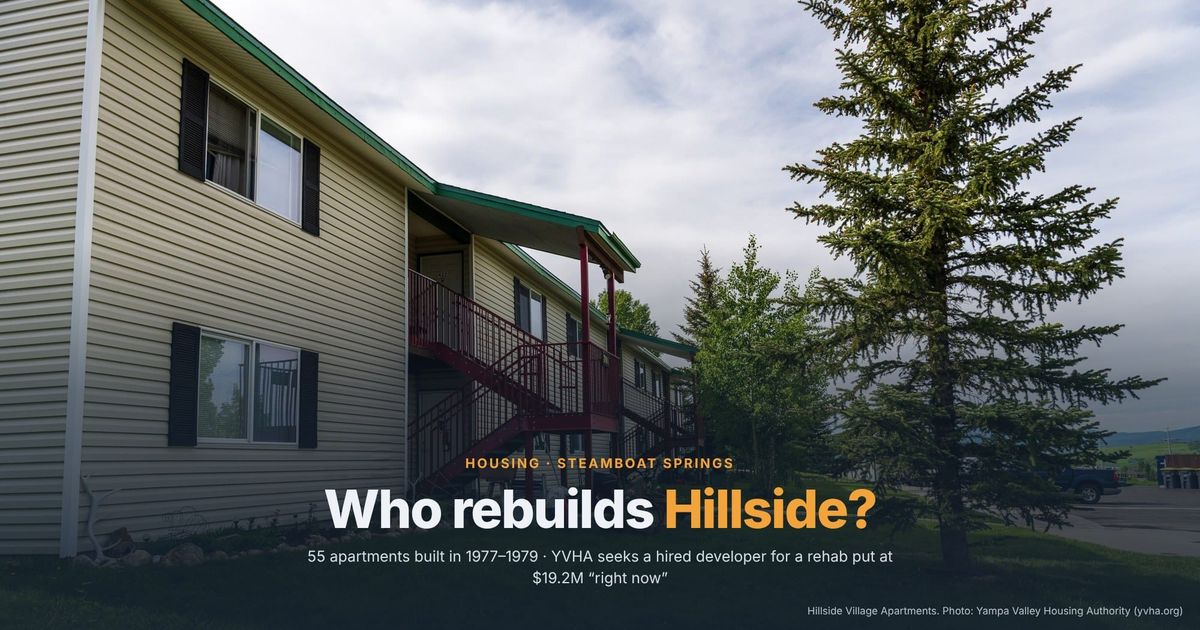
The Yampa Valley Housing Authority is seeking an outside developer to lead a planned rehabilitation of Hillside Village, the 55-unit affordable apartment complex it owns in Steamboat Springs. Its tax-credit consultant, Ryan Jones of RCH Jones, put the project's total development cost at $19.2 million "right now," and board member Mark Halvorson questioned the construction estimate at the board's Oct. 22 meeting. YVHA's request for proposals seeks a structure that limits its own risk, and Emily Katzman, a YVHA staff member, said being short-staffed ("We're missing one person") was part of the reason staff recommended a hired developer.
On Oct. 22, the board gave staff direction, without a formal vote, to seek a hired fee developer, according to the meeting video. The agenda had listed the Hillside item as an action item. Eight days later, YVHA posted a request for proposals for a "turnkey" developer to lead "all aspects of project execution," paid through a negotiated development fee.
The choice matters for the complex's residents, in a property where 36 of the 55 apartments currently have federal rental assistance, and for YVHA, which would sponsor the deal and take part in guarantees whose terms are still to be negotiated. In June, under the earlier plan, the minutes record a board member as saying that being guarantor of the project's permanent debt "has the potential to destroy YVHA." The new request seeks a structure that minimizes YVHA's guarantee obligations, though staff acknowledged Oct. 22 that a hired developer may not address guarantee risks.
What the board decided
Staff asked the board for two things, according to the video: authorization to pursue a 9% low-income housing tax credit application, due in February, and direction on who should own and develop the project.
Staff laid out the options. If YVHA acted as its own developer, it would keep 100% of a developer fee, currently modeled at $1.8 million, assuming an aligned investor partner, but would need an owner's representative, estimated at $320,000 to $400,000 over 32 months. Staff said a hired fee developer's cost was yet to be determined, but assumed it would take at least 50% to 80% of that fee, depending on who funds predevelopment, and listed as a drawback that it may not address guarantee risks. Staff recommended the hired developer.
"What I'm hearing is pretty much everyone's in favor of option two," Acting Executive Director Elliot Lawrence said more than 90 minutes into the item. Later, Board President Kathi Meyer asked, "Do we need a vote or we gave direction?" and added, "I feel like we have direction."
Staff said they would put out the request for proposals and keep refining the architectural drawings, and asked whether they had approval to submit a Dec. 1 letter of intent to the state; speakers replied that staff should go ahead, according to the video. Meyer asked staff to come back at the November regular meeting with their progress.
What YVHA is asking developers to do
The Oct. 30 request for proposals says YVHA intends to serve as the project's sponsor, applicant and sole member of its general partnership, will pay predevelopment costs, and "will participate in the project guarantee structure, to be negotiated with" the developer. A footnote in the request defines a turnkey developer as one whose services can "include controlling all decisions, construction management, timing, and/or outcomes for the project," and who "is not an Owner."
It lists "Minimize Risk to YVHA" as a goal, asks bidders to identify the risks they would assume, and seeks a structure that minimizes financing risk, cost escalation exposure, construction execution risk and guarantee obligations. Securing and guaranteeing the construction loan is "not required, but preferred by YVHA," and bidders willing to provide cost and completion guarantees get "additional consideration."
YVHA already has a team in place: JVD Architecture & Planning; I-KOTA for preconstruction cost estimating; RCH Jones/KDM for tax-credit advice; and Enterprise Community Partners for the USDA transfer application. YVHA "has not procured a General Contractor," the document says.
Questions are due Nov. 11 and proposals Nov. 30, with a selection planned for December.
The numbers, and the doubts
Jones told the board that third-party estimates gathered by staff put renovation at about $8.1 million, and that "the total development cost would be 19.2 million right now but again that's going to change."
The request for proposals assumes a construction budget of about $150,000 per apartment. For 55 apartments, that is about $8.25 million, by the Independent's calculation.
In June, under the earlier 4% tax-credit plan, Lawrence put the whole project at about $18 million, with about $10 million from tax credits, according to the minutes. In August, the minutes say, he reported that the estimates for the rehabilitation had "reached $7.7M so far."
Halvorson said at the Oct. 22 meeting, "I'm not a believer in the 8.1 million at all on the construction side."
Lawrence also compared Hillside with a firm's Front Range remodels, which he said typically land at $90,000 to $100,000 per apartment; he said Hillside is currently at $147,000 per apartment, based on drawings that are about 20% complete.
Why a hired developer
YVHA has cited risk: in July, Katzman, whom the request for proposals lists as YVHA's development project manager, presented three structures: YVHA as developer, a fee developer or a development partner, according to the minutes. She said a fee developer would not relieve YVHA from being the full guarantor, but YVHA would keep significant control over the project and the property, with less risk than acting as its own developer, the minutes say. A development partner would assume all the risk, as on YVHA's other tax-credit projects, but YVHA would give up ownership and control over how the property is managed.
Guarantee risk came up at the board's June meeting, where the minutes record board member Scott Yeates reviewing the risk of being guarantor of the permanent debt and making the warning quoted above; the board told staff to research alternatives. Halvorson suggested YVHA pursue a development partner, and several board members agreed an alternative to taking on the guarantee risk was needed, the minutes say.
YVHA has proposed a fee developer before: for its Hilltop housing project with the U.S. Forest Service, Katzman reviewed a structure using tax-exempt bond financing and a fee developer, Servitas, which she said would let YVHA retain control over the property's management, according to August minutes.
Staff also pointed to staffing: after the incoming executive director came up in the Oct. 22 discussion, Katzman said, "we're under capacity right now. We're missing one person." She said that was "part of the reason why I think we're recommending option two," the hired developer, because it "frees up staff time to work on other things," including the Slate Creek neighborhood.
Meyer said, "I will support two today," but called that support "reluctant" and voiced concern that staff were recommending it "because of our current staffing or unknown with the ED."
How Hillside got here
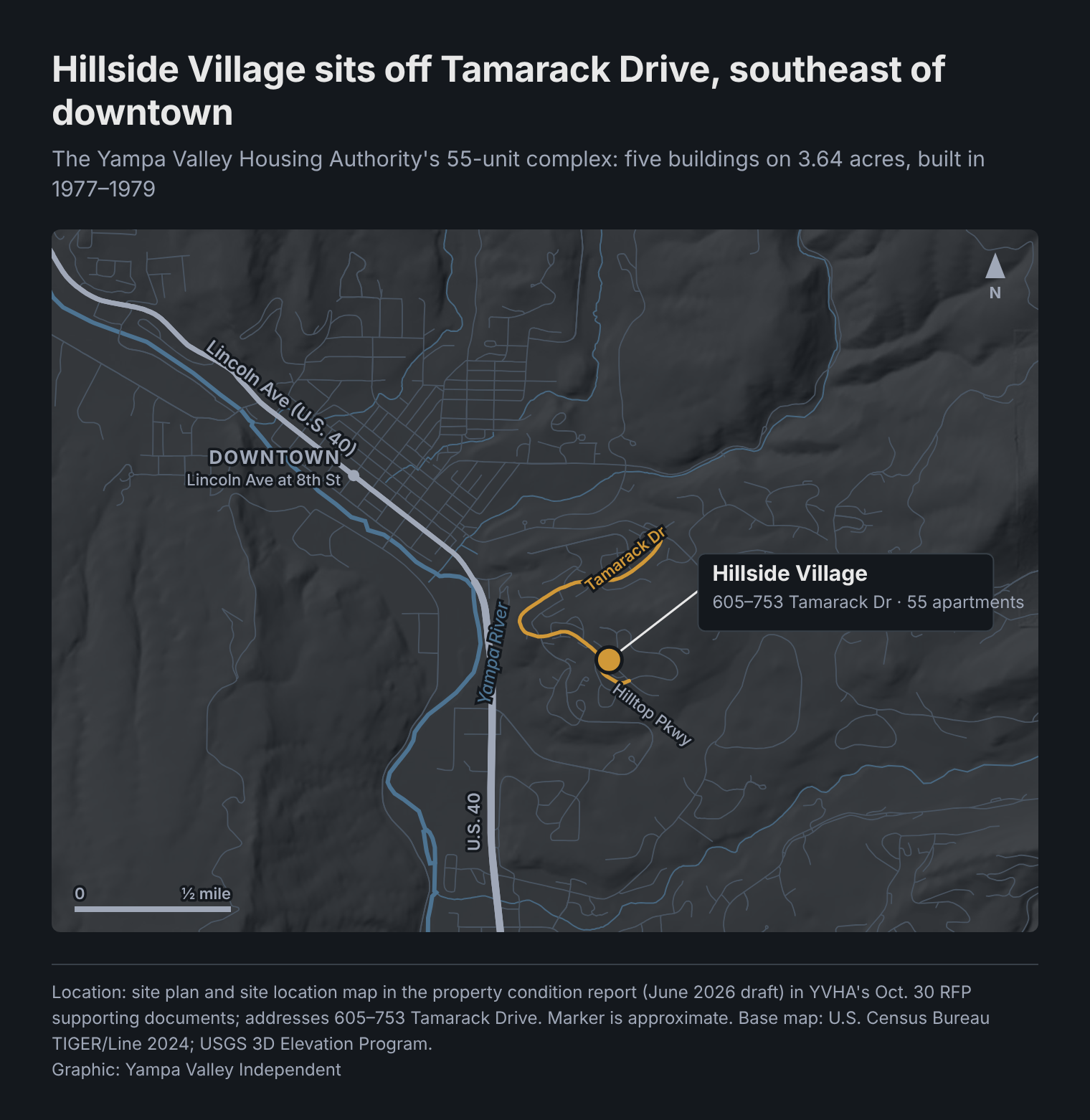
Hillside Village has five buildings on 3.64 acres, built between 1977 and 1979, with 20 one-bedroom and 35 two-bedroom apartments, according to the request for proposals. YVHA has owned and managed it since 2007. It is financed through the U.S. Department of Agriculture's Section 515 program, with 36 rental-assistance vouchers and a federal affordability covenant through 2037.
In June, staff planned to fund the rehab with 4% federal and state tax credits, with an application due in August. On July 2, the board reached consensus to postpone the application to 2027. The minutes record a discussion of what would happen if the cost estimate in the application proved inaccurate; one board member said refining the estimates would take about six months, and the minutes record another as offering that, "although run-down, the conditions at HSV [Hillside Village] are not unlivable." Lawrence said the electrical panels had been brought up to code and were the only identified risk to health or safety, the minutes say.
Arguments against waiting included the buildings' condition, the effect of a delay on residents and the risk of losing a $1.2 million state Division of Housing grant, which had been awarded as gap funding contingent on the 4% credits, the minutes say. "We had to forgo that grant opportunity," Katzman told the board Oct. 22.
In September, Lawrence reported that on the tax-credit consultant's advice YVHA would instead seek a 9% award, according to the minutes.
The request for proposals lists the planned financing: 9% federal tax-credit equity, a 4% acquisition credit, Colorado's state tax credit, the existing USDA loan, seller financing from YVHA and a deferred developer fee. Applications are due Feb. 1, 2027; the project is anticipated to start in April 2028, with 15 months of construction, and conversion to permanent financing is anticipated in June 2030.
What it means for residents
Rents were modeled about 10% above today's, "an average $98 increase," Jones said. Katzman said residents would be temporarily relocated during construction, 19 apartments would go two to three years without a rent increase, and a new 40-year affordability covenant would be added.
In June, Katzman told the board that because of the rental assistance program, the rent increase would affect about 19 households, and that YVHA would provide assistance for two to three years to cover it, according to the minutes. She also said three households exceed the 60% of area median income limit that would apply after the rehab, down from 80% now, and that YVHA would work with them to find other permanent housing. Lawrence said rents during relocation would stay the same, in comparable units, the minutes say.
The request for proposals lists "Minimize impacts on current residents" under its top goal, and says YVHA will hire a relocation consultant through a separate request.
YVHA's own review
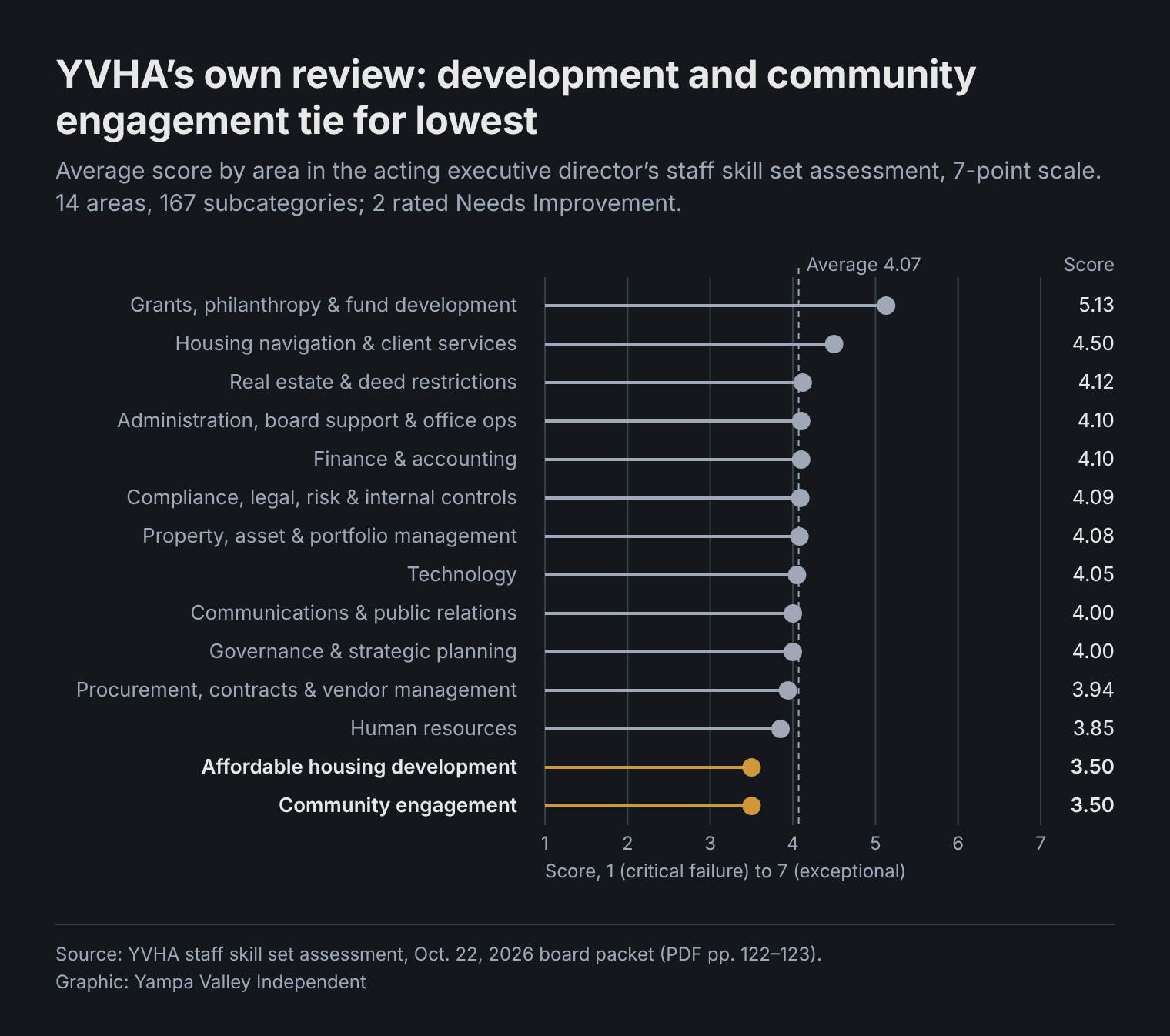
The same Oct. 22 meeting packet included an internal "Staff Skill Set Assessment" that lists Lawrence, as acting executive director, as its author. It rates 14 functional areas and 167 subcategories on a 7-point scale, built from all staff job descriptions and three years of annual reviews; it names no individual employees and attributes no score to a person, and it does not say how many employees work in each area. It says 44% of its metrics reflect a capacity issue more than a skills gap.
The review gives YVHA an organization-wide average of 4.07 out of 7, which it calls a "Solid Performer baseline," and no area was rated unsatisfactory. Grants and fund development scored highest, at 5.13. Affordable housing development and community engagement tied for lowest, at 3.50, the only two areas rated "Needs Improvement"; the review calls both "top priority focus areas."
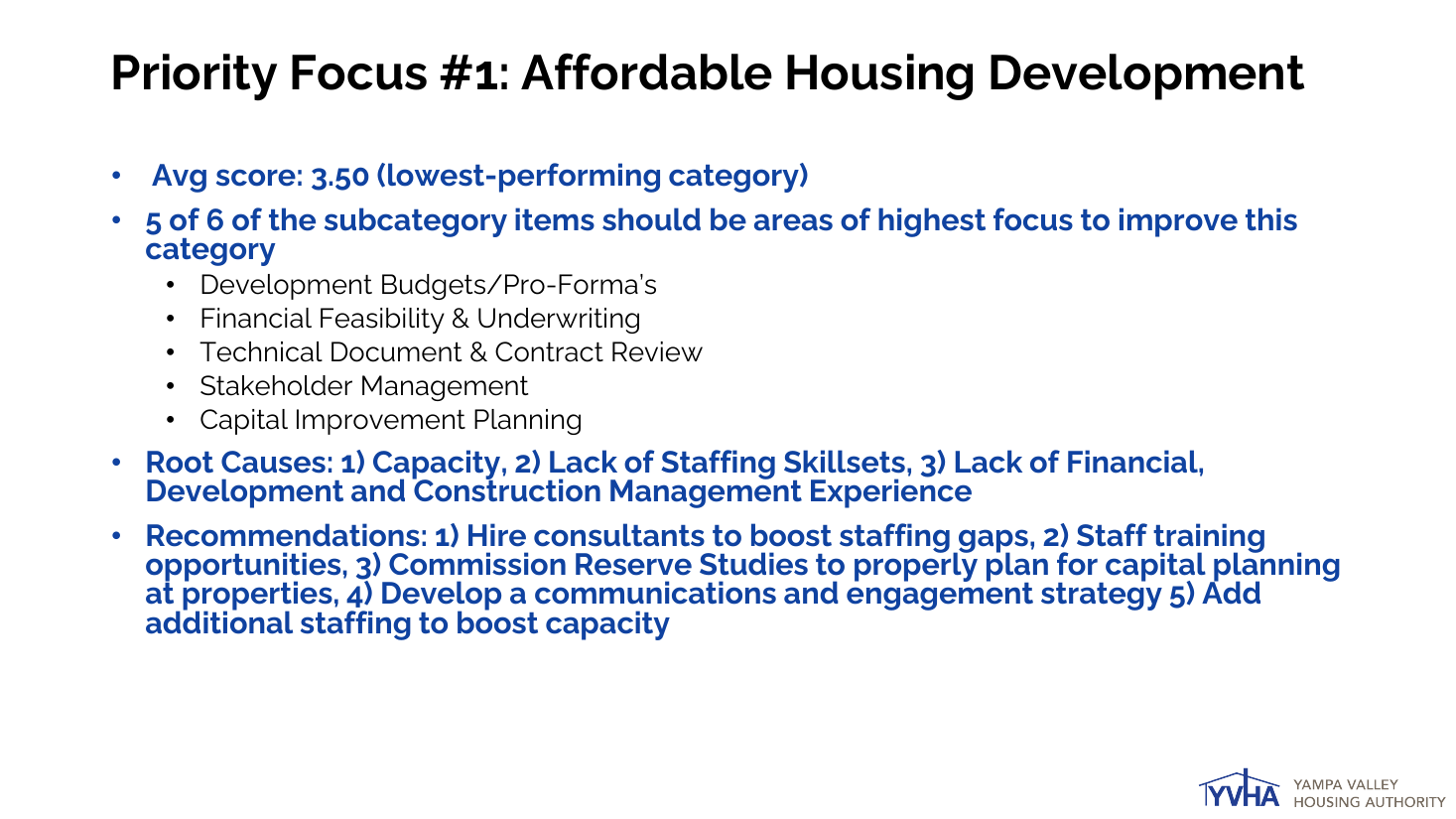
For development, the review lists three root causes: "1) Capacity, 2) Lack of Staffing Skillsets, 3) Lack of Financial, Development and Construction Management Experience." Its recommendations begin with "Hire consultants to boost staffing gaps" and end with "Add additional staffing to boost capacity." The weak spots it names include development budgets, financial feasibility and contract review.
Its action plan calls for engaging consultants "to assist with gaps in Development and Construction Management" and for check-ins at three, six and 12 months.
A companion review of the board's work teams proposes merging the real estate and property management teams as "sales at Cottonwoods wrap up," and dissolving the executive director search committee once a director is hired. Lawrence called the communications team critical "With our Mil Levy coming up for renewal," along with the Slate Creek annexation and the new director. In June, board member Cole Hewitt said the target was to put the levy renewal on the 2027 ballot, according to the minutes.
The board didn't take up either review Oct. 22; both were deferred to the Nov. 12 regular meeting, according to the video.
Other business
The board approved an updated personnel policy and employee handbook by voice vote, with no opposition heard on the video. The new rules limit staff use of artificial intelligence for work to YVHA-paid enterprise platforms and add a policy of deleting email after three years unless it is archived, according to the staff memo and the video.
An update to YVHA's intergovernmental agreement was moved to November, before a joint meeting, according to the video. The packet held no text of the agreement changes.
In a Slate Creek report, speakers described a first-phase annexation of 26 to 42 acres and roughly 250 to 300 homes.
YVHA's case
The request for proposals says Hillside "requires significant capital investment to preserve the essential affordable housing it provides to the community," and that "The highest priority of this project is preserving affordability for current and future residents."
Its plans include replacing plumbing and all new in-unit finishes, new siding and windows, and more accessible units. It seeks a structure that limits YVHA's financing, cost, construction and guarantee risks, and Katzman said a hired developer would free staff for other work. Jones told the board the $19.2 million total is "going to change."
The staff review also says no area was rated unsatisfactory or a critical failure, and that 44% of its metrics point to a capacity problem more than a skills gap.
Open questions
- What share of the developer fee will YVHA give up, what guarantees will YVHA itself provide, and will any bidder guarantee the construction loan?
- When will a construction estimate based on more complete drawings be ready, and what does the board expect it to show?
- How will YVHA fund two to three years without an increase for 19 apartments, what happens to those rents after that, and what will relocation cost and who pays?
- Will the board take a formal vote on the developer approach, the Dec. 1 letter of intent or the developer selection?
- What will YVHA do about the gaps its own review found, and what will consultants cost?
- What does the intergovernmental agreement update change, and when is the joint meeting?
The Independent is asking YVHA about the Hillside plans and the staff review and will update this story with its response.
By the numbers
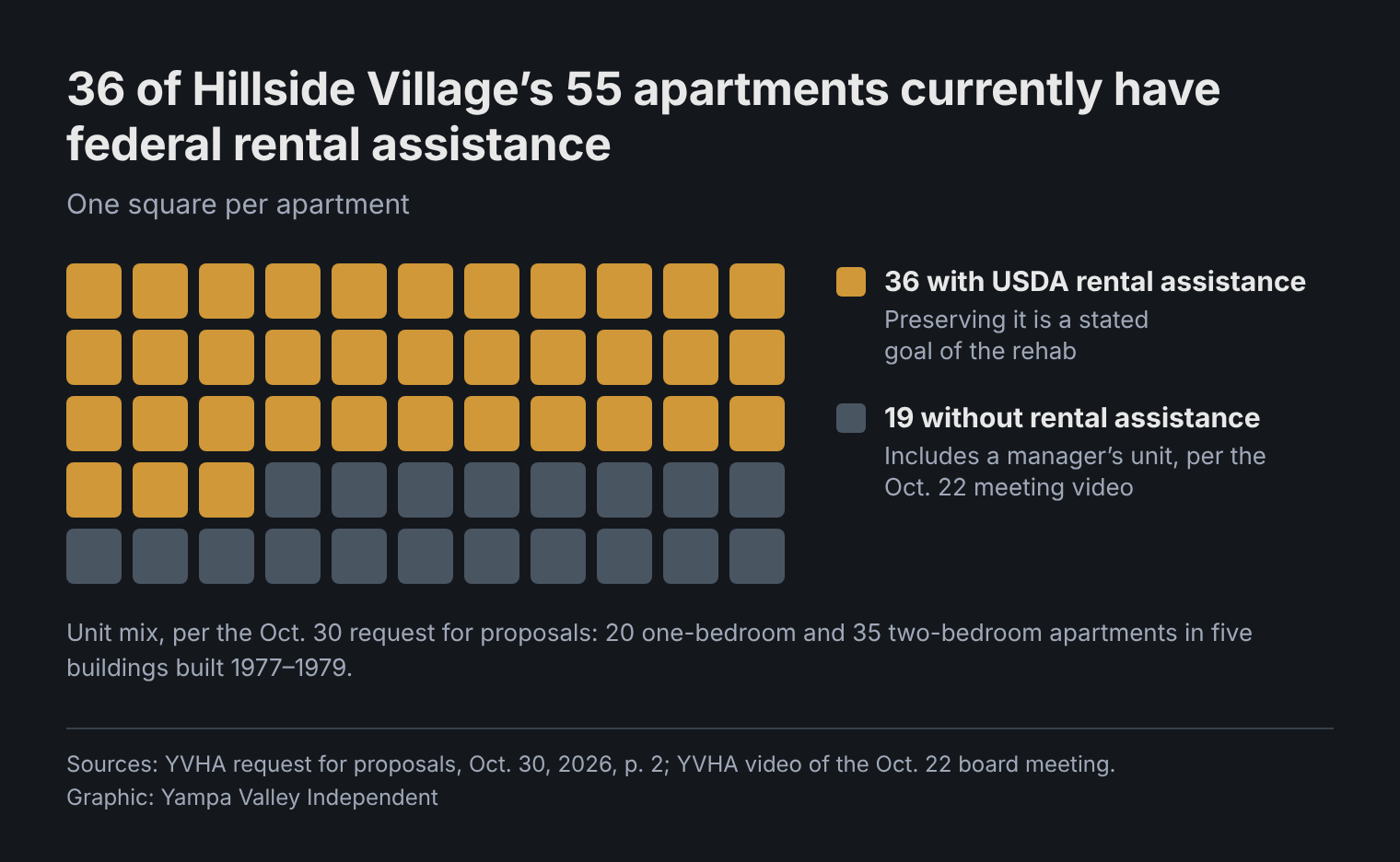
Preserving affordability is the project's "highest priority," the request for proposals says, starting with preserving the USDA rental assistance. The 19 apartments without rental assistance were described at the Oct. 22 meeting as 18 units plus one manager's unit. In June, staff said that because of the rental assistance program the rent increase would affect about 19 households, and that YVHA would provide assistance for two to three years to cover it, according to the minutes.
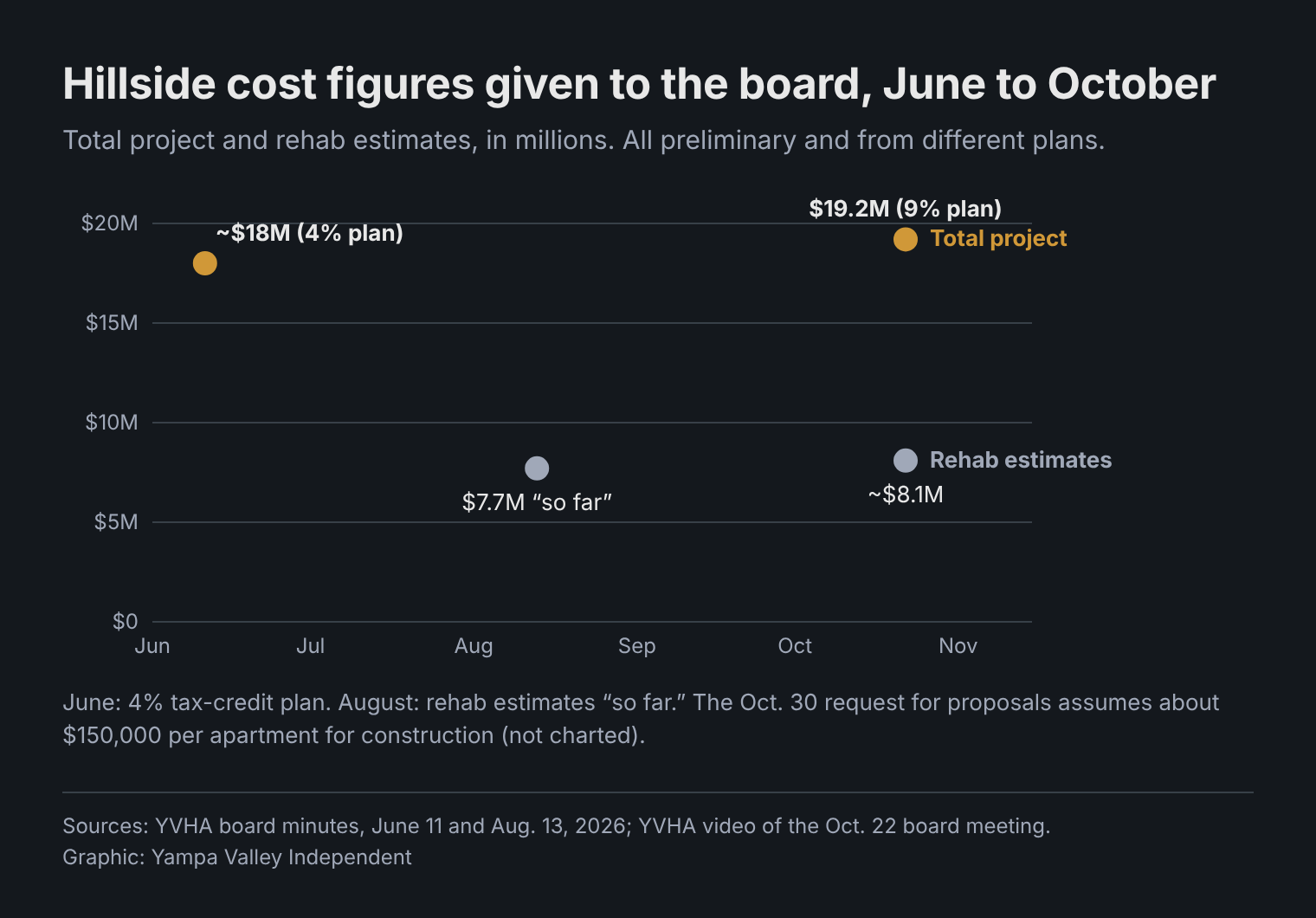
The cost figures are preliminary; the consultant said the $19.2 million total is "going to change." The $8.25 million figure is the Independent's calculation from the request for proposals.
What's next
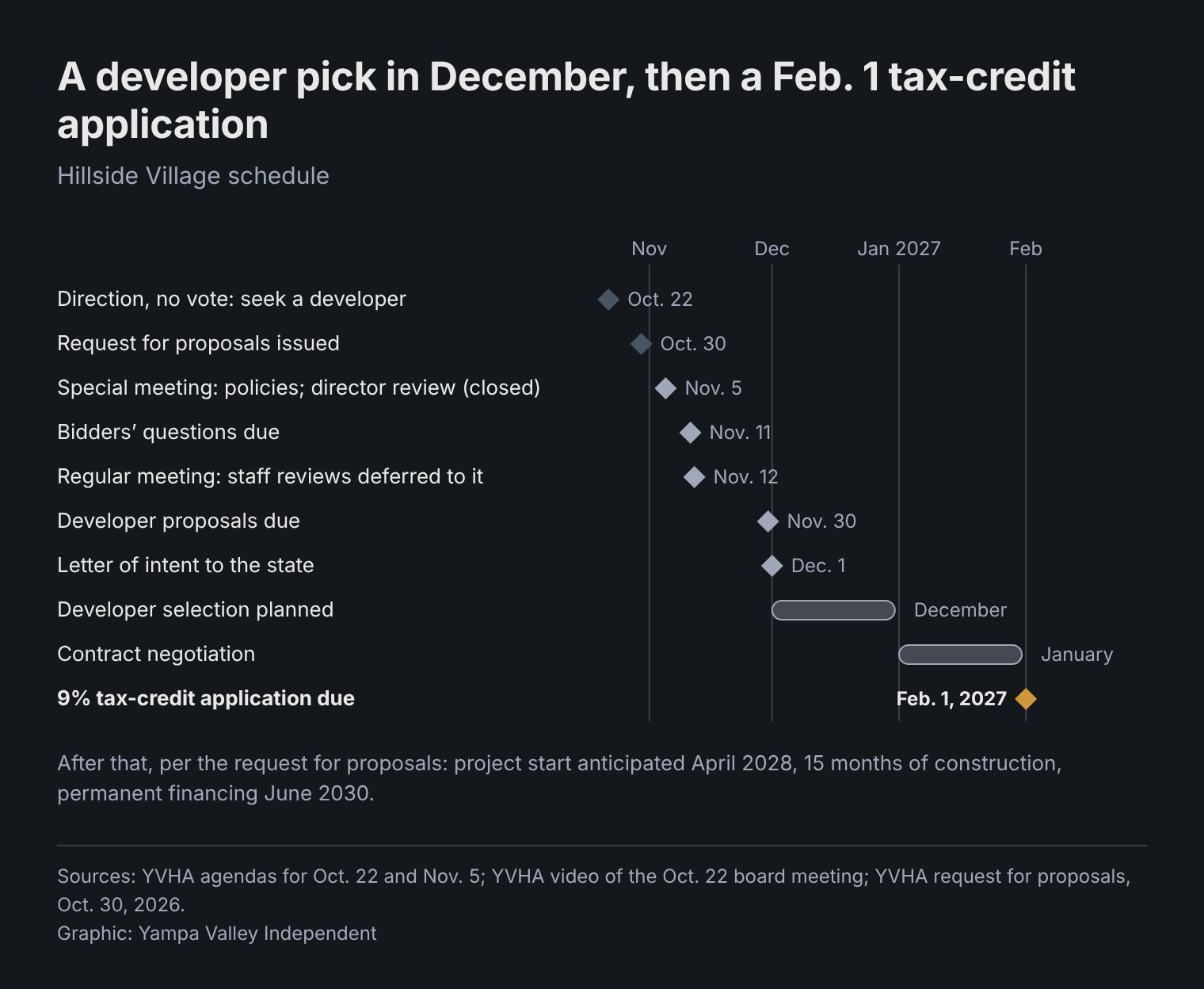
Thursday, Nov. 5: YVHA board special meeting, 8 a.m., Vectra Bank second-floor large conference room, 270 Anglers Drive, Steamboat Springs, and on Zoom (meeting ID 572 571 3720). The agenda lists five minutes of public comment, a 180-minute discussion and a 220-minute action item on governing policies, and a 25-minute closed executive session on the "Performance Review of the Acting Executive Director."
Wednesday, Nov. 11, and Monday, Nov. 30: Developers' questions on the Hillside request for proposals are due Nov. 11 at 5 p.m., and proposals Nov. 30 at 5 p.m.
Thursday, Nov. 12: YVHA regular board meeting, noon to 2 p.m., Community Room, Routt County Department of Human Services, 135 Sixth St., Steamboat Springs. The staff and work team reviews were deferred to this meeting, and Meyer asked that Hillside return then, according to the Oct. 22 video. No agenda had been posted as of Nov. 2.
Tuesday, Dec. 1: Letter of intent to the state for the 9% tax-credit application. The application is due Feb. 1, 2027.