
A county weed list, written for ranch country, is about to govern every yard in Steamboat. The expected fix is chemical spraying.
The city attorney told Council its summer weed notices leaned on a code that "does not apply" to single-family homes. Council gave first reading, 5-1, to court fines anyway, under a county eradication list written for ranch land. Second reading is Nov. 10.

In July the city was mailing weed notices to homes; one letter the Independent reviewed warned of fines "not to exceed $2650.00 per violation per day." On Tuesday the City Attorney told Council that staff "should not have been relying on the community development code" for those notices, that the city "did not withdraw" them, and that it has never, to his knowledge, taken a weed case to court. About 20 minutes later Council gave first reading, 5-1, to an ordinance creating the court action its own staff report says the code "does not currently authorize," with a fiscal impact the report puts at "None."

Key points
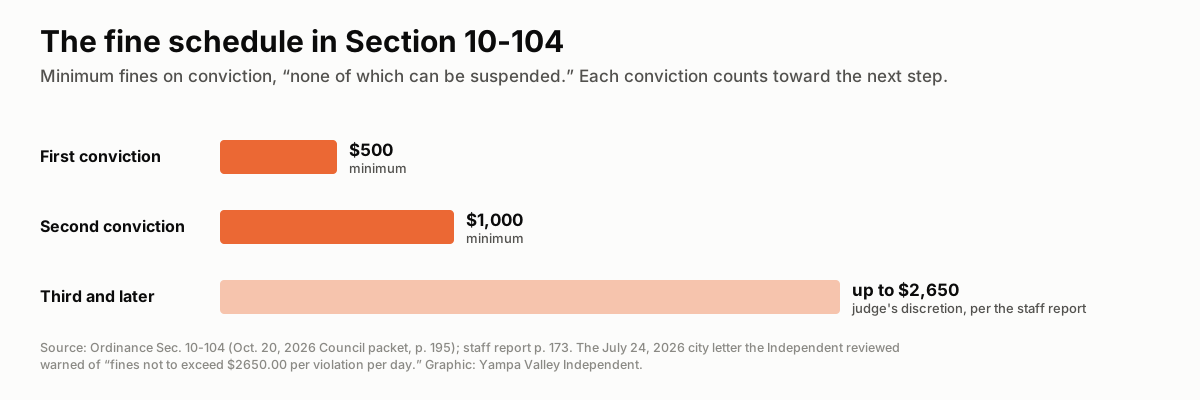
- Steamboat Springs City Council gave first reading Tuesday, 5-1, to an ordinance letting the city cite property owners into municipal court, with minimum fines of $500 and $1,000, for not acting on weeds the city's adopted plan marks for eradication. Second reading and a public hearing are tentatively set for Nov. 10.
- The City Attorney said this year's notices "should not have been relying on the community development code with respect to single family duplex properties," that the city "did not withdraw the notices," and that he is "not personally aware of any case in which we have taken anyone to court over a weed issue." Objections to the notices' validity were "beside the point," he said, because the ordinance would "fix all those problems to the extent that they are problems."
- Both staff reports put the fiscal impact at "None." The same report says abatement "depends on the availability of staff time and a budget" that "are not always available"; the attorney said one employee already spends "about half his time" on weeds. Asked whether an owner can simply cut a listed weed down, the Planning Director said "I'm not like the expert on noxious weeds," then "yes, you can cut the weed down, I believe." The ordinance requires a plan "in alignment with" a county document that defines eradication as years of monitoring until the seed bank is exhausted.
- The eradication list is Routt County's, written by a county board of "local landowners" for a plan whose jurisdiction "is the unincorporated area of the county." Staff could not say Tuesday whether a recent county change to the list is in force inside the city.
- The plan Council adopted says that "Under the Act" no local government may compel eradication "without first applying the same measures" to its own adjacent land; the City Attorney said holding the city's own land to the standard is "not a legal requirement."
- The item was discussed at all only because of an email. Before taking it up, Council members asked "what's the point" of a public request to pull a consent item when the requester is not in the room.
Disclosure: Michael McLarney, the Independent's owner and editor, received a notice this summer and has written to Council opposing the ordinance. He is a party to this matter. He edited this story and directed the Independent's coverage of the ordinance.
Steamboat Springs City Council voted 5-1 Tuesday, Oct. 20, to give first reading to an ordinance that would let the city cite property owners into municipal court, with minimum fines of $500 and $1,000, for weeds the city's adopted plan marks for eradication.
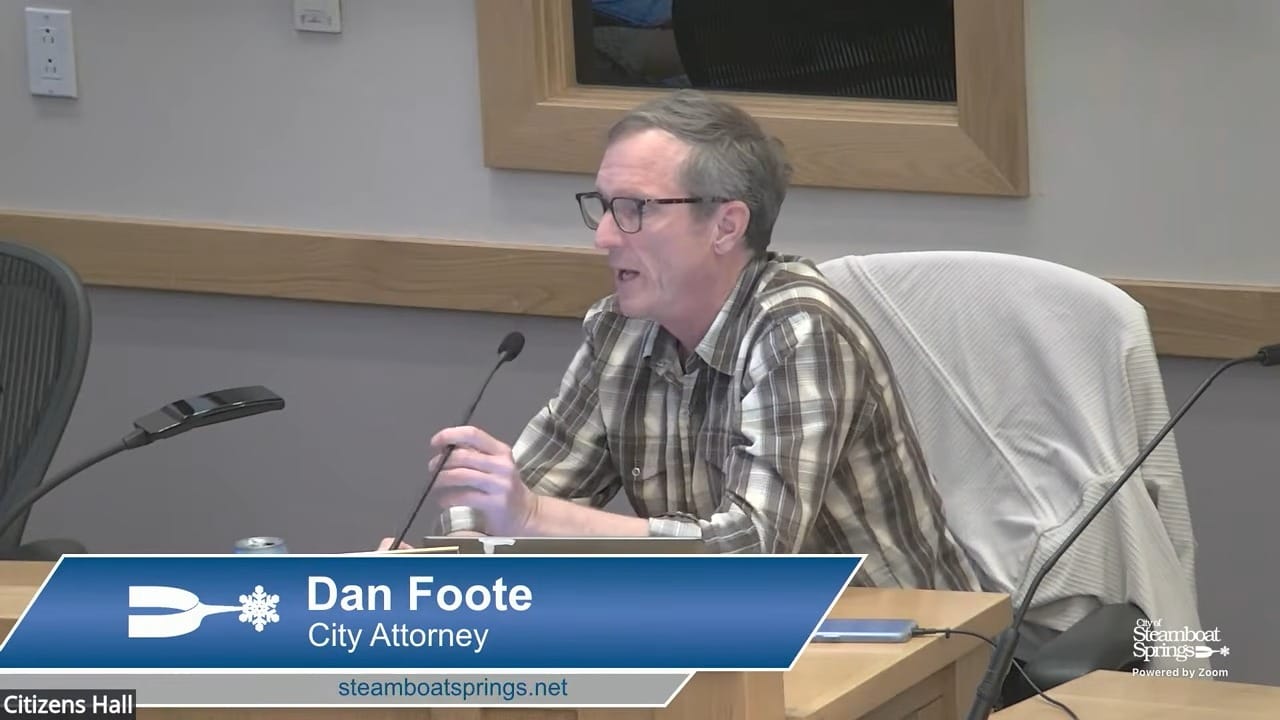
The vote came about 20 minutes after City Attorney Dan Foote told Council that the weed notices the city mailed this summer "should not have been relying on the community development code with respect to single family duplex properties," that the city "did not withdraw the notices," and that he is "not personally aware of any case in which we have taken anyone to court over a weed issue."

What the city said in July, and what it says now
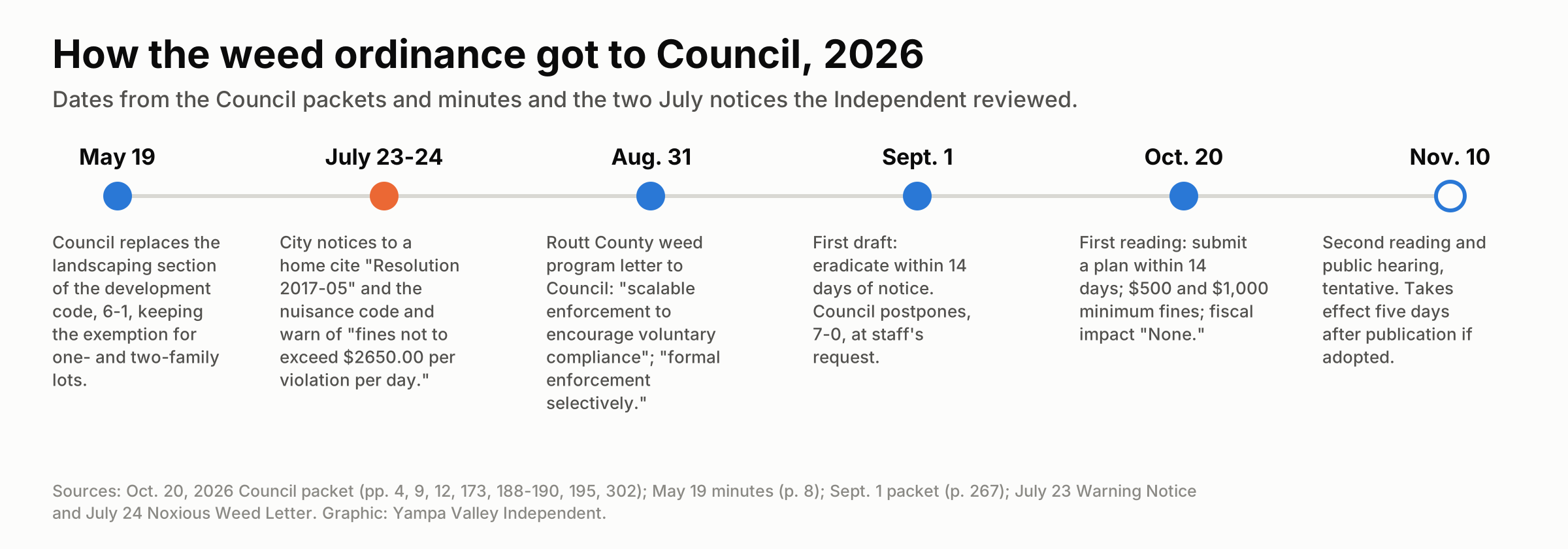
The Independent reviewed two notices the city sent to one home in July; the owners are not named here. A July 23 Warning Notice, signed by the city's short-term rental compliance officer, cited "Resolution 2017-05" for "Failure to control noxious weeds on property" and the nuisance code's six-inch weed rule, set an Aug. 10 deadline, and warned that the property "may be subject to a court ordered abatement and/or your tenant may receive a citation." A July 24 "Noxious Weed Letter" also cited Resolution 2017-05, named whitetop, curly dock and Canada thistle, said "Immediate action needs to be taken," recommended "a contractor with a licensed commercial applicator," and warned of penalties under Section 1-15 "with fines not to exceed $2650.00 per violation per day."
The staff report that went to Council three months later, from Assistant City Attorney Jennifer Bock and Planning Director Rebecca Bessey, says one existing development-code provision "does not apply to single family and duplex properties," that the nuisance code "does not refer to 'noxious weeds'" and leaves "the term 'weeds'" undefined, "an obstacle to enforcement," and that "The Municipal Code does not currently authorize this type of municipal court action." It names two existing enforcement mechanisms, the development code and the nuisance code, and does not mention Resolution 2017-05. Council itself had kept the development code's exemption for "One-family and two-family residential principal uses on individual lots" when it rewrote that section May 19 on a 6-1 vote. Of the three weeds in the July 24 letter, only whitetop is on the eradication list the ordinance would enforce.
On Tuesday Foote told Council the city brought the ordinance because "this year we learned that the tools that we have in the event we need to go to court are not adequate." The notices, he said, had rested on two sources: "I believe that we should not have been relying on the community development code with respect to single family duplex properties. But I think that the nuisance provision was an independent and adequate ground to take enforcement action." He acknowledged "some questions as to whether or not that kind of a court case would be successful," and said public comments disputing the validity of the notices were "kind of beside the point because the whole purpose of the ordinance tonight is to fix all those problems to the extent that they are problems."
The Independent has asked the city what Resolution 2017-05 is, how many notices went out this year to single-family and duplex homes and on what authority, and whether the July 24 letter's warning of daily fines under Section 1-15 will be corrected.
"Fiscal Impact: None"
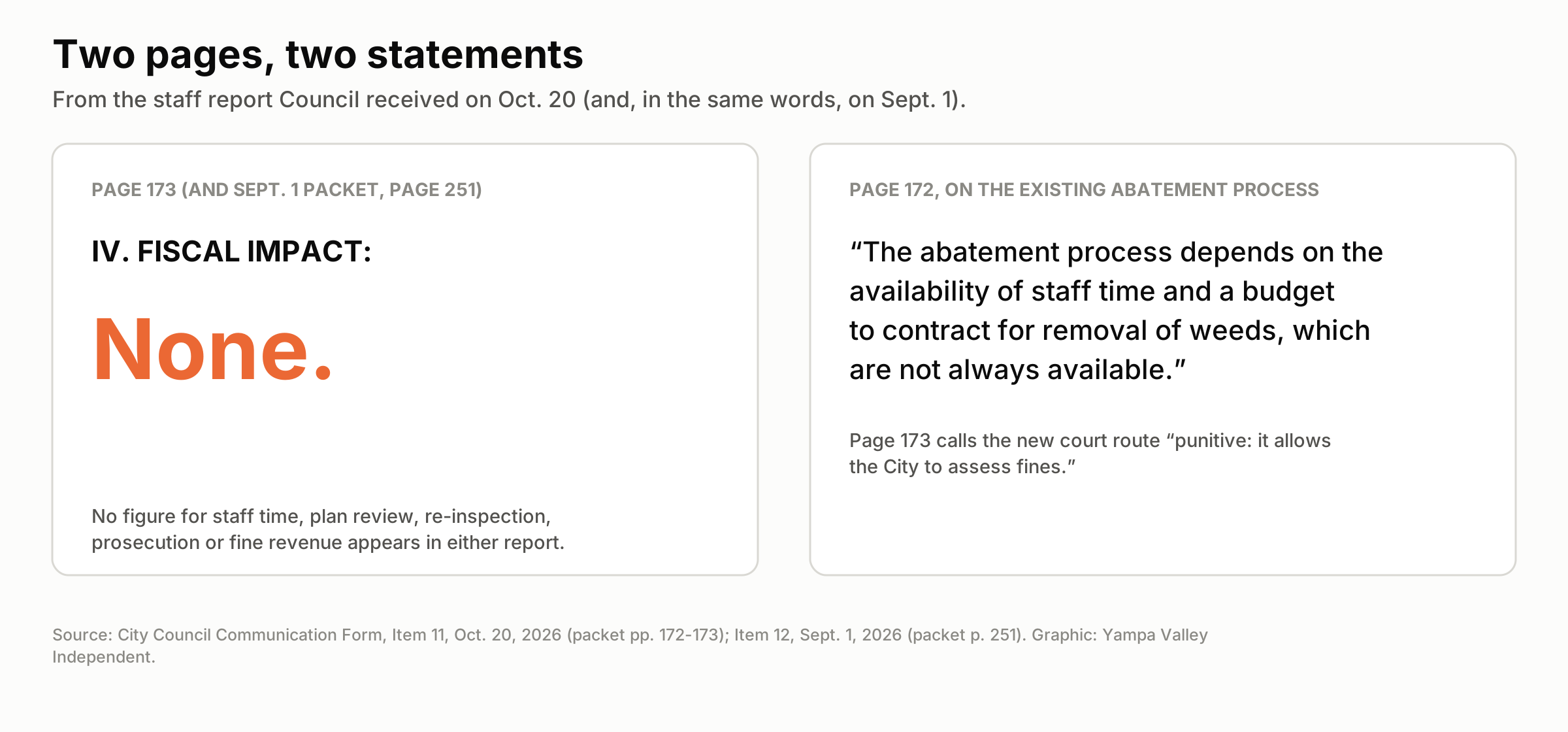
Both versions of the staff report, Sept. 1 and Oct. 20, give the ordinance's fiscal impact in one word: "None." One page earlier, the same report says the city's existing abatement process "depends on the availability of staff time and a budget to contract for removal of weeds, which are not always available," and describes the court route as "punitive: it allows the City to assess fines." It does not estimate staff time, prosecution costs or fine revenue. Other staff reports in the same two packets explain a zero fiscal line; this one does not.
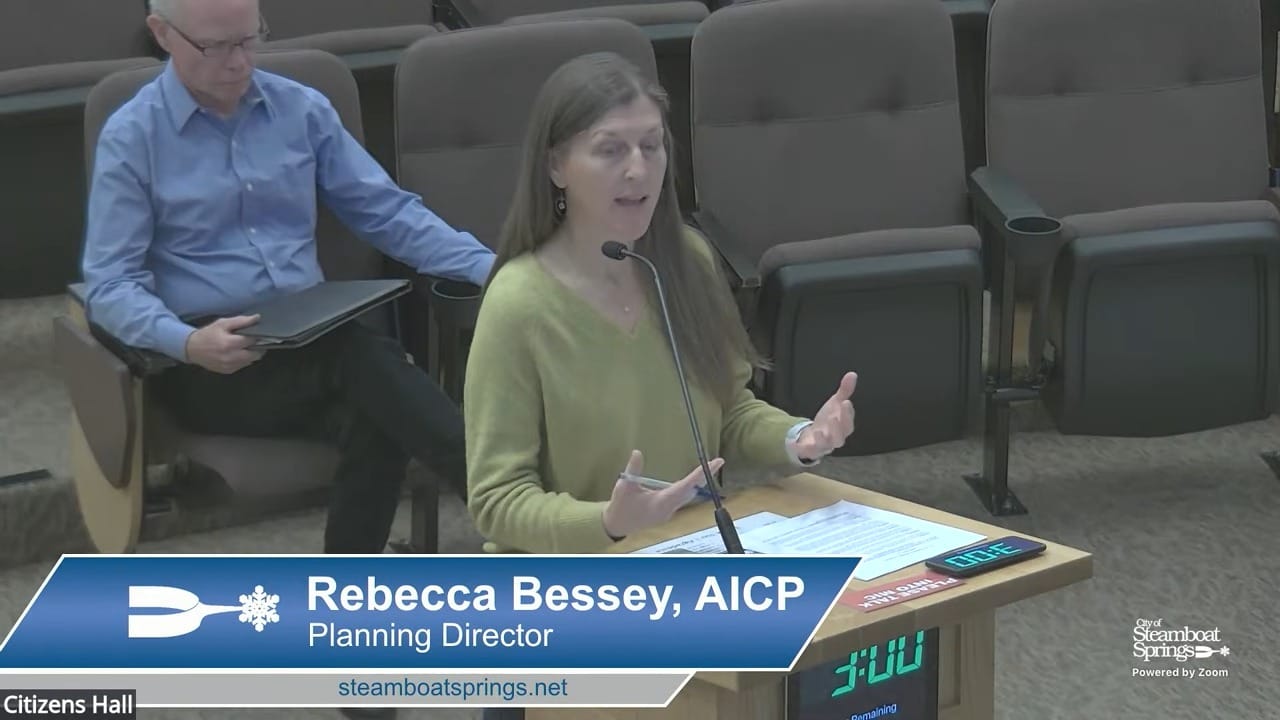
On Tuesday Foote said the city already has "an employee who spends about half his time" on weed investigations, education and notices. Bessey said the city has "never to my knowledge actually cited anyone to municipal court" and that she does not foresee the ordinance changing "how we operate" or increasing "our workload in any fashion." The city has no funding to offer owners, she said; the county gives out free herbicide.
A Council member asked the question the staff report does not answer: whether an owner who gets a notice must produce a plan within 14 days or can simply cut the weeds, "because those are very different fiscal outcomes for a homeowner." Bessey answered, "I have to apologize. I'm not like the expert on noxious weeds," and then, "So, yes, you can cut the weed down, I believe."
The ordinance says otherwise, or at least more. It requires the owner to "develop a plan in alignment with the City's adopted weed management plan for eradication and submit the plan to the City" within 14 days, and makes it an offense to fail "to make commercially reasonable efforts implement the plan." The adopted plan defines eradication as reducing a weed's reproductive success "to zero" and continuing "until the existing seed bank is exhausted"; it tells landowners to "monitor the area for a number of years to ensure seeds are depleted," and lists whitetop's seed longevity at three years. It says it is the landowner's "responsibility to develop an Integrated management plan," and that management criteria for listed species "will be made available to the public... as they are developed." The July 24 letter recommended "a contractor with a licensed commercial applicator."
The ordinance does not say who at the city would review an owner's plan, by what standard, or who would re-inspect over the years a plan runs. The city's planning staff page lists one code enforcement officer and one short-term rental compliance officer, who signed both July notices; the city's own weed page sends residents to the county program, which reviewed 14 compliance plans this year, for help. The six steps the ordinance, the adopted plan and the state Noxious Weed Act would require, and the staffing on each side, are in the graphic.
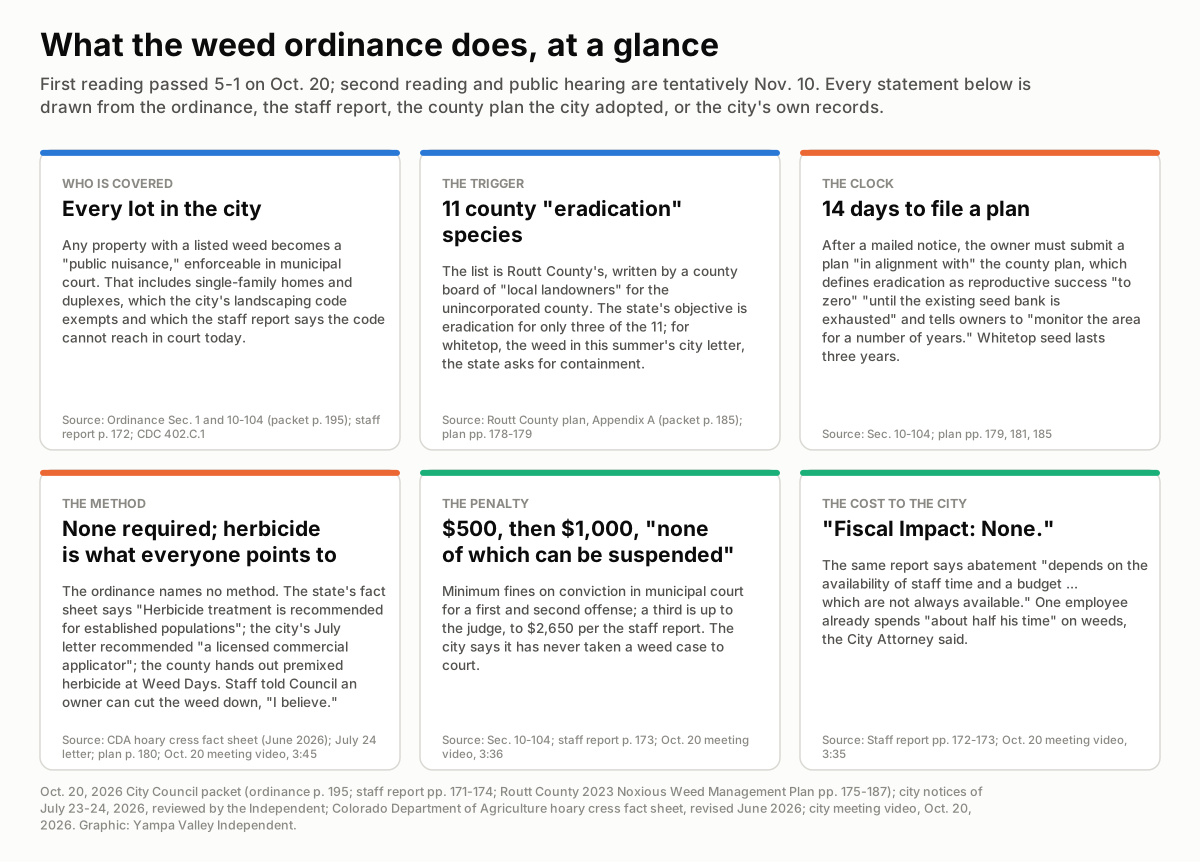
The same night Council voted 5-1 to put $130,216 back into the 2027 budget for a city forester it had cut, and reappointed the municipal judge, an independent contractor, at $2,625 a month, a 5 percent raise. The Independent has asked the city what "None" assumes, who would review plans, re-inspect and prosecute, and what that would cost.
A county list, and no plan written for the city
State law requires the city to adopt a weed management plan. The only plan the city has adopted is Routt County's 2023 plan, used under a 1997 agreement and most recently re-adopted Feb. 17 by Resolution 2026-12. That plan says the county's jurisdiction "is the unincorporated area of the county," apart from land a municipality uses for municipal services, and its introduction describes weeds that "devastate hay meadows" and "poison livestock." Its eradication list, Appendix A, is "set by the Routt County Noxious Weed Advisory Board and Routt County Weed Management Program"; "Local landowners make up" that board, which reports "to the County Commissioners for final approval." The list marks 11 species for eradication. The state's objective is eradication for three of them; for whitetop, the species in the July letter, the state's objective is containment.
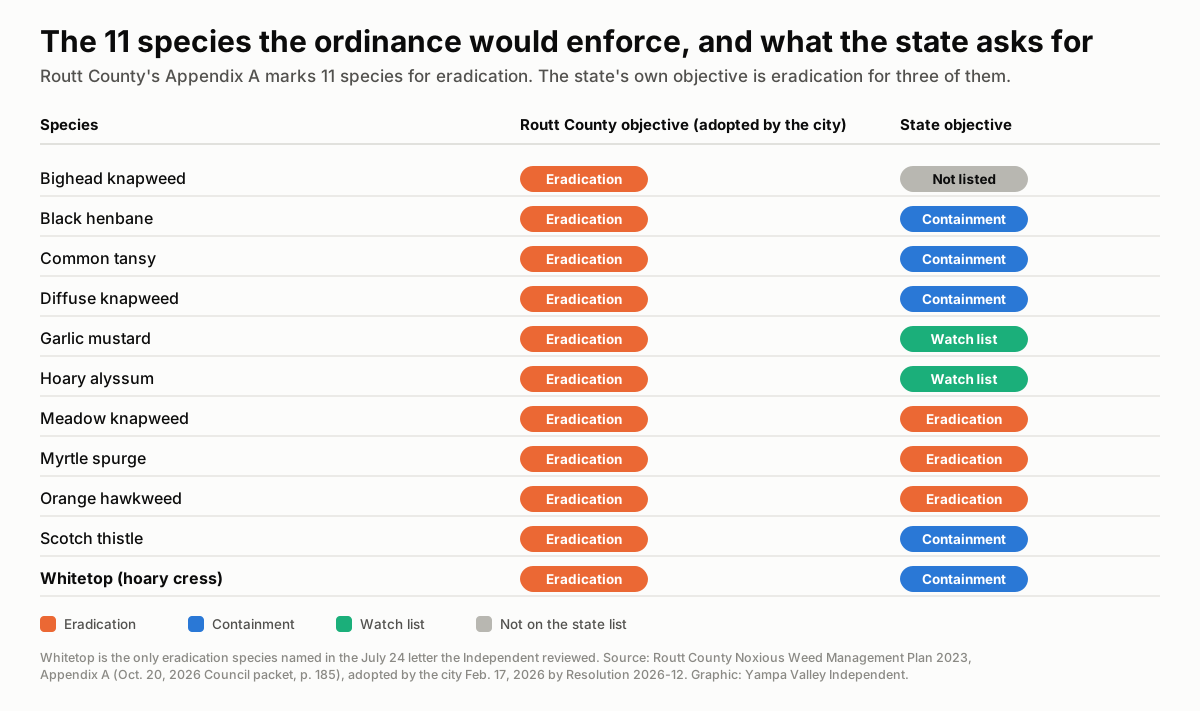
Asked Tuesday whether the county's list changes flow automatically into city law, Bessey said "Routt County recently made a change to the weed list. So I need to confer with Dan on whether we need to update our adoption," and that an answer was "on my radar" for second reading. The one resident who spoke, in support of the ordinance, told Council that asking for the city's plan "takes you and says go to the county's plan," that "The county plan says specifically this is for unincorporated" parcels, and that the county weed board "agrees with me in that the city does not have a plan and should get a plan." Foote said staff wrote the ordinance for eradication species only because the county does not take owners to court over the others.
Who wrote the list, and who lives with it
The weeds that could put a Steamboat homeowner in court are chosen by a county board of "local landowners" for a plan written for the unincorporated county, whose introduction describes weeds that "devastate hay meadows" and "poison livestock." The county program says it "has no jurisdiction for enforcing or initiating work in City limits." The products that program recommends for whitetop carry their own instructions. The federal labels for Telar XP, and for the registered product sold as Weed-B-Gon MAX Plus Crabgrass Control, say "Keep people and pets out of the area during application" and to keep them out until sprays have dried; the lawn product's label says it is "toxic to fish and aquatic invertebrates"; the metsulfuron and chlorsulfuron products carry groundwater advisories and are "classified as having high potential for reaching surface water via runoff for weeks after application," and one warns it "may adversely impact the forage and habitat of non-target organisms," including pollinators. Telar's label says "DO NOT use on lawns"; the lawn product's says "For residential lawn use only." The county's own label file for its Weed Days giveaway holds four labels: two metsulfuron-methyl products marked "Caution," a surfactant, and Cornbelt 4 lb. Amine, a 2,4-D concentrate whose label carries the signal word "Danger": "Causes irreversible eye damage and skin irritation. Harmful if swallowed. Do not get in eyes, on skin or on clothing. Avoid breathing vapors or spray mist." It adds that the product "may be toxic to fish and aquatic invertebrates." The file does not say how the county mixes the solution it hands out. The city's own weed page says that after its contractor sprays, "As a precaution, children and pets should stay off sprayed areas for 24 hours."

The city's own land
Neither the ordinance nor the staff report says whether city parks, open space and rights-of-way would be held to the eradication standard; Section 10-104 speaks of "property owned by that person." The city's weed page says the city "is required by state and federal mandates to manage noxious weeds on its lands, like private property owners." The plan Council adopted says that "Under the Act" no local governing body may "compel the eradication" of such species "without first applying the same measures to any land or rights-of-way owned or administered by the local governing body that are adjacent to the property."
Asked Tuesday whether the ordinance opens the city to compliance issues on its own property, Foote said no. The state statute's abatement provision, "that we could use but that we don't," gives an owner a defense if the city has not kept its nearby property in order, he said; that is "an equitable issue" the city would take into account, but "it is not a legal requirement." Bessey said streets and parks crews do "a lot" of weed management on public land, and a Council member said: "I see them up on Emerald Mountain beginning of the season, you know, every year white tops." The Public Works Director said the city's contractor, SaveATree, sprays "all noxious weeds" in rights-of-way: "Any weeds we see, any weeds we get reported to us, we go spray until they're dead. Now, oftentimes it takes several years to kill some of these stands."
Chemicals, or not
The ordinance does not say how an owner must remove a weed. The adopted plan lists "biological, chemical, cultural, and mechanical control techniques," and the state Act favors methods "which are least environmentally damaging and which are practical and economically reasonable." Bessey told Council an owner can, she believes, cut a listed weed down. The state's own fact sheet for hoary cress, revised in June, says mowing "several times before the plants bolt stresses" the plant, and that "Herbicide treatment is recommended for established populations, due to the plant's root system and ability to resprout." The county tells residents to mow or weed-whack whitetop "every couple weeks" before spraying the regrowth with herbicide from its Weed Days, where it hands out "up to 5 gallons of premixed herbicide solution formulated to target whitetop and many other broadleaf weeds"; its FAQ names Telar, Escort and Cimarron for rural land and Corsair and Weed-B-Gon MAX for yards. The July 24 letter told the homeowner to hire "a contractor with a licensed commercial applicator." The city's contractor sprays rights-of-way as many as three times a year, with the city's advice that "As a precaution, children and pets should stay off sprayed areas for 24 hours," and, the Public Works Director said, "until they're dead," which "oftentimes" takes several years. The plan an owner's eradication plan must align with ends only when "the existing seed bank is exhausted." The city has not said which products its contractor uses; the Independent has asked.
What the ordinance says, and doesn't
The offense is written as failing "to make commercially reasonable efforts implement the plan"; the word "to" is missing. Section 6 leaves the public hearing date blank: "shall be held on ________." Section 8 declares the ordinance "necessary for the immediate preservation of the public health, safety, and welfare," the finding ordinarily attached to an emergency measure, while Section 3 gives an ordinary effective date, "five (5) days after publication following final passage," and the tentative Nov. 10 agenda lists it for second reading. After the Sept. 1 postponement, staff replaced a 14-day eradication deadline with the plan requirement and added the fine schedule, and told Council it could adopt either provision alone. The Independent has asked whether the ordinance is an emergency measure and whether the drafting will be corrected before second reading.
How it got discussed
The ordinance was on the consent calendar, where items pass in a single motion unless a Council member or a member of the public asks to pull one. It was pulled because the Independent's owner, Michael McLarney, asked by email; he did not attend. Before taking it up, Council members asked whether an emailed request should count: "our rules are that anybody can pull something. Um, but if you're not here, what's the point?" one said. "And if you're not online, what's the point?" said another. A third: "I read his letter saying, 'I will pull this if you don't.' I didn't hear him saying, 'Please pull.' I mean, he asked us to." The agenda states that "any member of the Council or the public may request withdrawal of any item from the Consent Calendar for further discussion."
The city's case
The staff report says weeds "pose a serious threat to native plant populations, soils, water, wildlife, agriculture, recreation, and property values," that the city "rarely, if ever, is compelled to use the nuisance provisions," and that "Occasionally" an owner does not respond and "it is necessary for the City to take enforcement action." Abatement, it says, carries "potential liability" for damage to property or other plants. Bessey told Council the city's practice is a "soft letter" first, then a notice of violation, then a compliance plan and re-inspection, and court only if the plan is not followed; the ordinance, she said, "just provides that tool in our toolbox." Foote said the city's code enforcement has "had success with the education and the notice of violation," and that the ordinance is meant "to clarify that authority."
The Independent emailed nine questions to the city's communications office on Oct. 22, copying the City Manager, the City Attorney, the Planning Director, City Council and the staff involved in the July notices, with a deadline of 5 p.m. Friday, Oct. 23. Responses were pending at publication; this story will be updated with the city's answers.
What's next
Second reading and public hearing: tentatively Nov. 10, 5 p.m., Centennial Hall, 124 10th St., or on Zoom (meeting ID 985 289 877). Public comment is limited to three minutes. If adopted, the ordinance takes effect five days after publication.
Sources
This story is drawn from public records: the Oct. 20, 2026 City Council agenda packet (the ordinance, the staff report and the Routt County 2023 Noxious Weed Management Plan, Item 11); the Sept. 1 and May 19 packets; the city's video of the Oct. 20 meeting (Item 11 begins at 3:33:48); two city weed notices sent to a neighboring home in July 2026, reviewed by the Independent; the city's Noxious Weeds page; Routt County's Weed Abatement Program page, weed FAQ and 2024 Chemical Giveaway Labels file; the Colorado Department of Agriculture's hoary cress fact sheet (revised June 2026); the Colorado Noxious Weed Act (C.R.S. 35-5.5); and the EPA-accepted labels for MSM Turf Herbicide, Telar XP Herbicide and EH-1437 Herbicide (the registered product behind Weed-B-Gon MAX Plus Crabgrass Control). Archive copies of every document, with the page each statement rests on, are kept by the newsroom.