
Oak Creek asks voters for a permanent 2-cent sales tax as costly water and sewer work looms
Ballot Issue 2A would raise the town's sales tax from 3% to 5% for capital projects, with no end date. The town's books show how big those projects are next to the $400,000 a year it would raise.
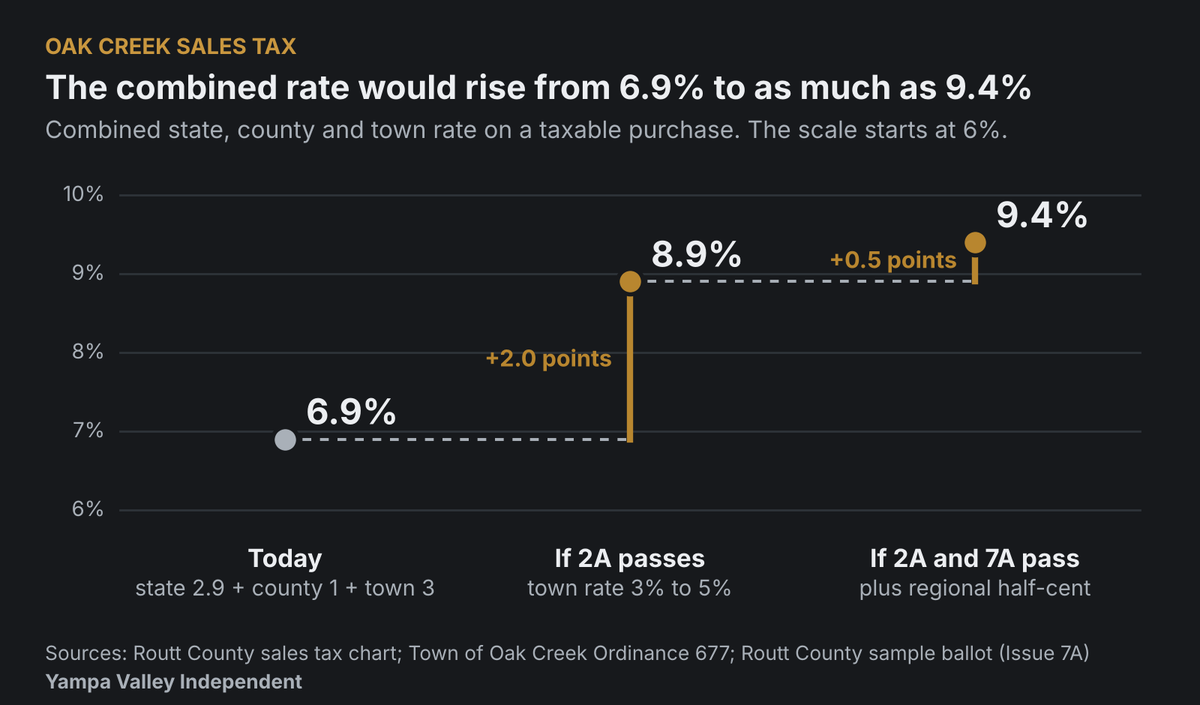
Ballot Issue 2A would raise the town's sales tax from 3% to 5% for capital projects, with no end date. The town's books show how big those projects are next to the $400,000 a year it would raise.
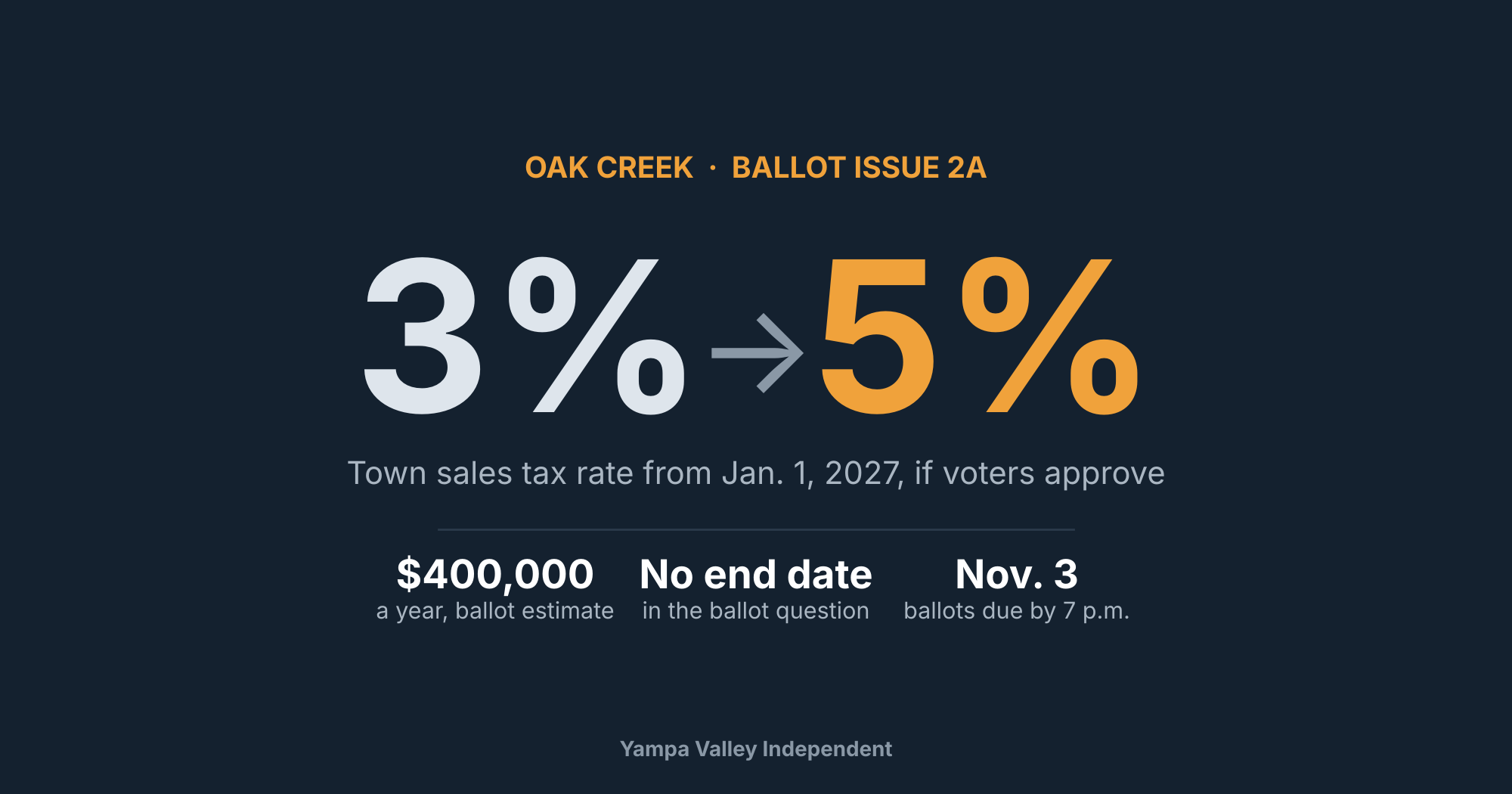
Oak Creek voters are deciding whether to raise the town's sales tax by 2 cents on the dollar, permanently, to pay for infrastructure that town leaders say is failing.
Ballot Issue 2A would lift the town's rate from 3% to 5% on Jan. 1, 2027. The ballot question says taxes would rise $400,000 a year "and by whatever additional amounts are raised annually thereafter," with the money spent "solely for the construction and rehabilitation of capital improvements." It sets no end date. The $400,000 estimate is close to the $411,486 that the town's existing 2% general-purpose sales tax raised in 2025; a separate 1% tax goes to the streets budget.
The town's financial reports show what that money would be up against. The water fund's 2026 budget counts on $6.9 million in grants for capital work, none of which had arrived by the end of August; the biggest project the town has described, a dam spillway rebuild, isn't scheduled to start until May 2027. The sewer fund owes $898,126 on a bank loan. And a consultant has recommended double-digit water and sewer rate increases in each of the next two years.
What the tax would pay for
The ballot question doesn't name projects. Ordinance 678, on the town board's Oct. 8 agenda, would set the rules: the money could go to capital projects including "public facilities, public infrastructure, and water and sewer capital improvement projects," and could be pledged to repay bonds. The money couldn't be used for repairs and maintenance booked as operating costs, or for projects of $1,000 or less.
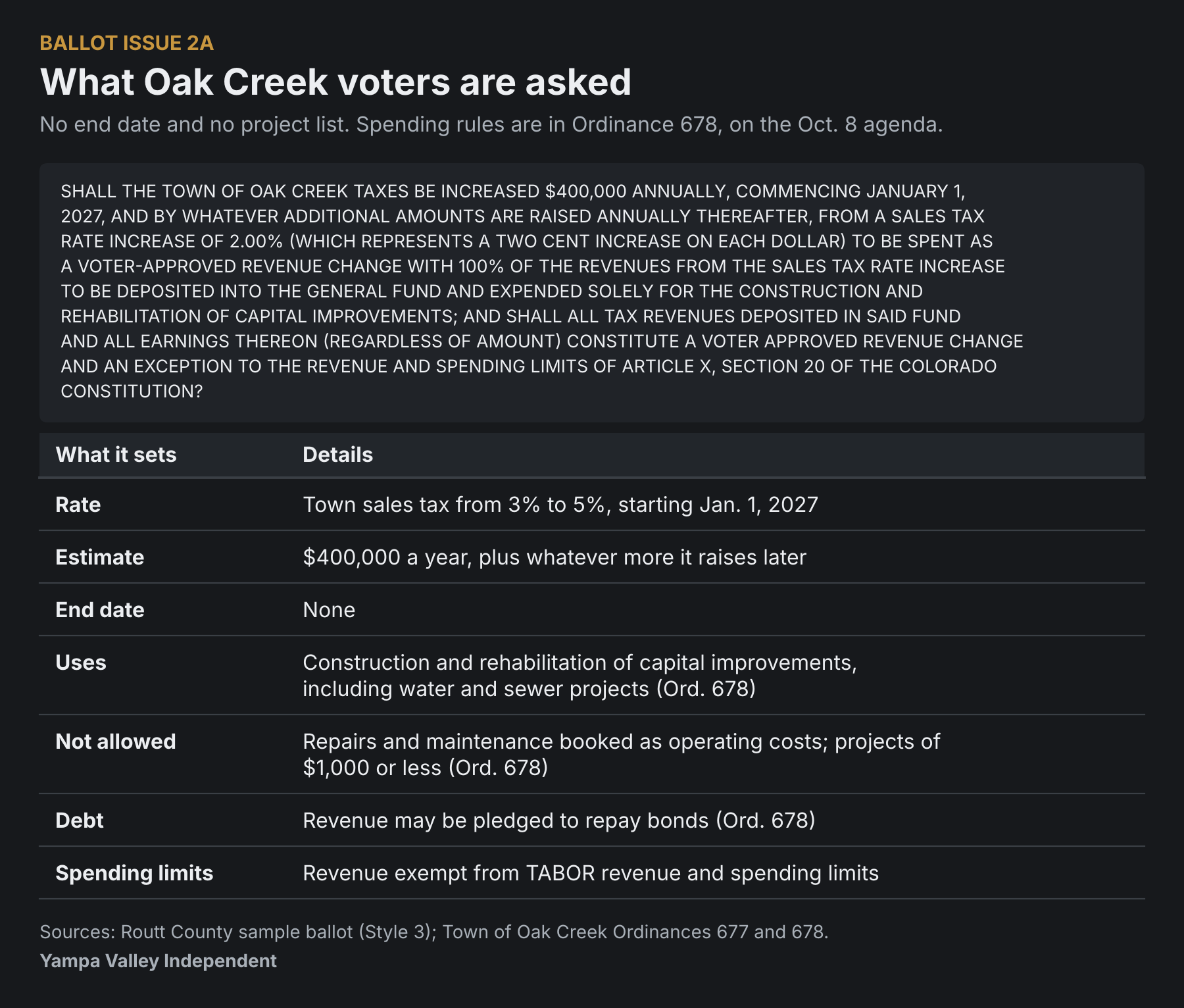
The ordinance would take effect only if 2A passes. In August, Town Administrator Louis Fineberg told trustees no decision was needed until after the vote, according to draft minutes. The ordinance was on the Sept. 24 agenda for discussion and the Oct. 8 agenda for possible approval. Minutes of the Oct. 8 meeting had not been posted as of Oct. 16, so the town's records don't yet show whether trustees adopted it.
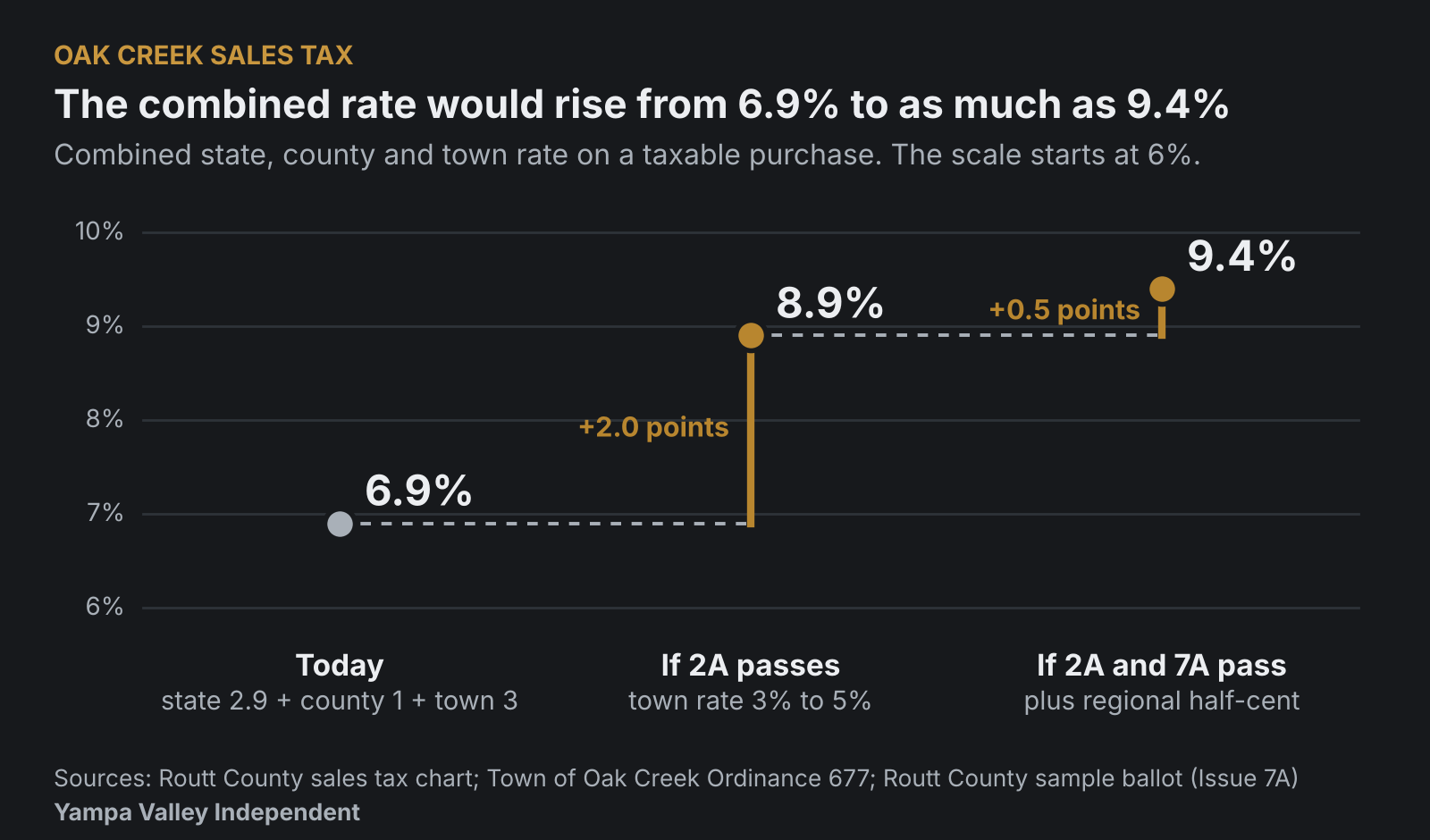
Shoppers in Oak Creek now pay 6.9% in combined sales tax on taxable purchases: 2.9% to the state, 1% to Routt County and 3% to the town. That would rise to 8.9% if 2A passes, and to 9.4% if voters also approve Issue 7A, the half-cent regional transportation tax on ballots in Routt County and Craig.
Why town leaders want it
Trustees settled on 2% in July. Discussing a consultant's utility rate study on July 9, Mayor Melissa Dobbins said the town was "in a dire situation," while Fineberg said it was "very much in control," according to the minutes. Later that night, the minutes record him saying a sales tax measure "would essentially fix the Town's infrastructure problems over a ten year period."
On July 23, when the ballot question was on the agenda, Fineberg cited an 80% loss of water from the town's system and "a lot of infiltration," or outside water leaking into sewer lines, according to the minutes, which add that the town was "not in a position to fund projects that need to be taken care of." He argued that a sales tax spreads the cost to visitors, and that a loan for a single project could take 30 years to repay. In August, he said engineers would reassess water losses once the last new meters were in.
Not everyone agreed. On July 9, Trustee Sascha Stanger said he was fine with a ballot measure but not if it applied to groceries. Trustees Julie Gregory and Kelly McElfish favored 2% on everything, Dobbins said 2% was what the town needed, and Mayor Pro Tem Bernard Gagne said at least 1% was needed, groceries included.
On July 23, Stanger said he wasn't a fan of sales tax. Resident Alvin Powell, who is running against Dobbins for mayor, objected to taxing essential items and suggested trimming town beautification spending. Fineberg told Powell there was "nowhere to trim." He told Stanger that this year's and last year's budgets were "decent" because they included money for a police department the town didn't have, a cushion he said would go away under a new agreement with the Routt County Sheriff's Office.
What the books show
Water. The 2026 water budget plans $7.26 million in capital spending, to be paid largely with $6.9 million in grants. Through Aug. 31, the fund had received none of the grant money and had spent $100,464 on capital work, about 1.4% of the capital budget, according to the town's August financial statements.
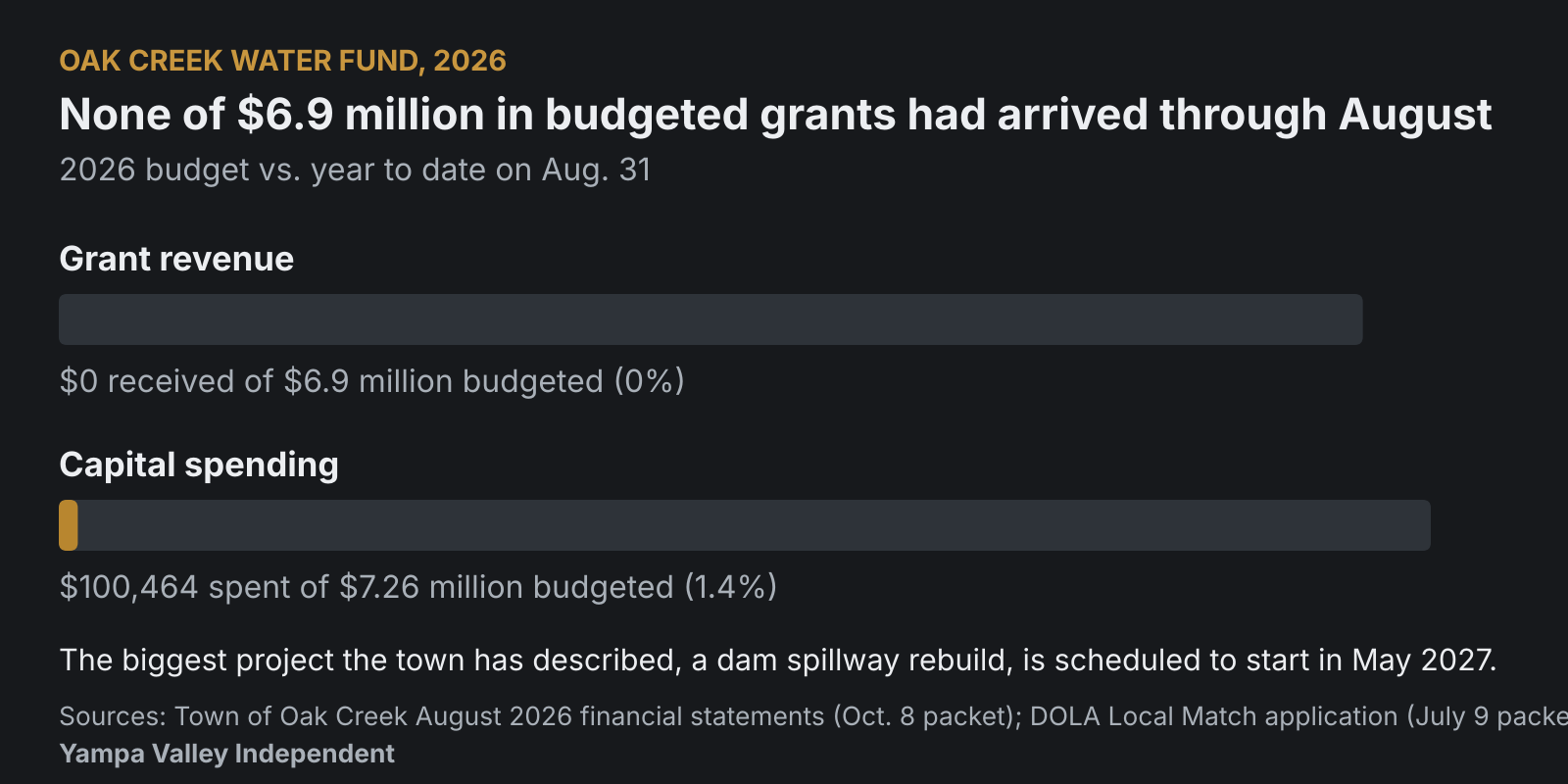
The biggest project the town has described is a rebuild of the Sheriff Reservoir dam spillway, estimated at $5.3 million and scheduled to start in May 2027. In a June 30 application to the state, which trustees were asked to approve after the fact on July 9, the town said FEMA had awarded $3.45 million for it, "subject to the completion of environmental and historical clearances," and listed $1.24 million in other local and regional money, including $250,000 of its own. The state has offered $620,000 more if the federal award comes through, and the Colorado River District's grant pays out as work proceeds. Fineberg told trustees in August that the town had the funding it needed for the dam project, according to the minutes.
The first draft of the 2027 budget, in the Oct. 8 packet, repeats the 2026 budget line for line, including the $6.9 million grant line. It doesn't yet include revenue from 2A.
Sewer. The sewer fund owes $898,126 on a Bank of the San Juans note, nearly twice the $481,155 in cash the fund held at the end of August. Its payments on what the ledger calls a sewer project loan run about $56,650 a year. The 2026 budget has the fund spending $80,037 more than it takes in, and an engineering proposal trustees took up in July lists eight upgrades for the wastewater treatment plant.
Rates. On July 9, consultant John Krajewski of JK Energy Consulting recommended raising water rates 10% and sewer rates 15% in both 2027 and 2028, and electric rates 9%, citing water and sewer shortfalls driven largely by capital projects and debt. He put the first year's increases at $26.02 a month for a typical household across the three utilities. None of the board agendas the town posted from July 9 through Oct. 8 included a vote on water, sewer or electric rates; the packet for the Oct. 22 meeting had not been posted as of Oct. 16. Fineberg said in July that rates should cover operating costs and the sales tax should pay for capital projects.
Reserves. The town does have savings. Its general fund had an unassigned balance of $1.61 million at the end of August. This year's budget has the fund spending $733,612 more than it takes in, including $675,000 for capital outlay. Through August, though, the fund was $48,467 in the black and had spent none of that capital money and $33,950 of its $451,746 police budget.
How to vote
Mail ballots must be received by 7 p.m. on Tuesday, Nov. 3. Oak Creek voters will also choose between Dobbins and Powell for mayor, vote in the trustee race and decide Issue 7A.
Quotations from town meetings in this story come from the town's minutes, which summarize what was said. This story is based on Town of Oak Creek board packets from July 9 through Oct. 8, 2026, the Routt County sample ballot and Routt County's published sales tax rates.